
Lately, I’ve been hearing the same question from some of the most sophisticated investors I know.
We know superintelligence is coming soon –maybe as early as 2027. So what do you invest in when AI will solve everything?
If AI can solve cancer, why fund a biotech? If AI can write better code than any engineer alive, why back a software company? If superintelligence will eventually optimize every market, predict every trend, and design every product better than any human team — what, exactly, is the venture investor’s role in that world?
This isn’t a pessimist’s question. It’s a believer’s question. The people asking it have looked “the transition” straight in the face. They know AI superintelligence will exceed human capability not in one domain, but in every domain. They’ve followed the story all the way to the end. And at the end, they’ve hit a wall.
That anxiety contains a hidden assumption: that the future is already written and the role of human agency is already over. It’s not. We are still in the early phase. We still get to control the path of travel toward superintelligence.
Here is the answer to the question, up front: early-stage investing is society’s targeting system. Every company we fund is a decision about what superintelligence gets pointed at — which problems get defined as worth solving, which industries get the data, the talent, and the institutional position to undergo their transition to superintelligence first, and on whose terms.
The rest of this essay is about why that’s true, and why it’s also the best thing you can do for your portfolio.
Superintelligence is Inevitable
Most groups predicting the rise of superintelligence have shortened their estimates in recent years. AGI around 2030 isn’t totally outlandish anymore (what we hear in secret SF AI meetings is that it could be as early as 2027 or as late as 2029).
The thing is, once superintelligence actually arrives, it will feel as if it arrived overnight. AI’s intelligence isn’t scaling linearly — a little smarter each year. It’s scaling exponentially. By the time it reaches human-level intelligence, we’re already on the near-vertical part of the curve.
It will be as smart as the most intelligent person alive — briefly — and then it will blow past that entirely. The intelligence humans have to work with will be many times smarter than the smartest humans who have ever lived.
Writer and cartoonist Tim Urban drew this in 2015. It illustrates how this will feel to us very well:
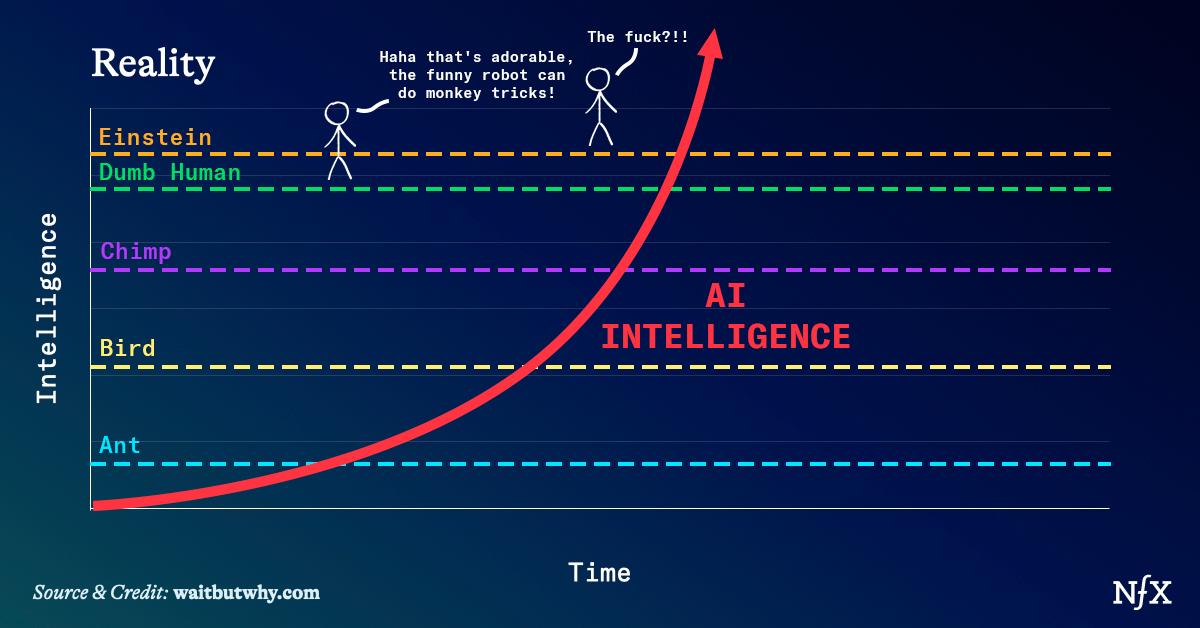
When superintelligence arrives, it will feel rapid. And that speed is exactly why the choices we make now matter so much.
What does this mean? The aiming has to happen before arrival, because aiming takes time and arrival won’t allow any.
The assets that determine where superintelligence makes its first impact — proprietary datasets, regulatory approvals, clinical relationships, distribution, trust — take years to build. A superintelligent model with no access to oncology data, no FDA pathway, and no physician network does not cure cancer on day one.
The companies that have spent the preceding decade building those positions are the ones the wave amplifies. By the time superintelligence arrives, it will be too late to start building the on-ramps. Our job — and our founders’ job — is to build them now.
VC is Society’s “Targeting System”
The above exponential intelligence curve is the accelerant. But each industry has its own challenges — its own data, its own unknowns, its own friction. That’s what determines what “the transition” looks like and what world is created on the other side.
We don’t even have superintelligence yet, and we are already seeing entire industries rewritten thanks to the vision of talented entrepreneurs and the enormous rate of improvement in current AI capabilities.
Coding is being addressed first because it is a great fit for AI’s current level of intelligence (and it’s a massive market!). The rules are well-defined, the data is abundant, and the feedback loops are fast. The world we live in today is one where anyone can truly code their dream application. That’s because investors backed companies like Cursor, Anthropic, and OpenAI. Without investors backing these startups, we don’t get the three-person unicorn, and the explosion of creativity in the hands of small teams.
Legal is next for the same reasons – LLMs are naturally great with language, and law is based on precedent. Many tasks are formulaic. The intelligence we have fits neatly into those industries and has created great companies like EvenUp.
The coding AI transition was inevitable. The legal AI transition was inevitable. What was not predetermined was who it would serve first — and who it would serve best.
This is just the beginning. The problems we tackle are only getting more complex, and the stakes are getting higher. How we solve them will matter enormously when we get to fields like biology, where lives are on the line.
We know that biology will be one of the hardest industries for AI to “solve” – that’s because there are still vast swaths of biology that humans simply don’t understand yet, and the industry is complex (clinical trials, regulations, etc). But AI will have the intelligence to solve major problems in biology, given time and data.
So what we must do today is define the problems most worth solving.
That’s one of the reasons we are so bullish on longevity: there is truly no greater wealth than your health, and aging is upstream of eight out of ten most common causes of death in the United States. Not to mention, it’s possibly a $1.2 quadrillion opportunity. (The harder the problem, the larger the prize when it’s solved.)
It’s also why we have decided to invest in women’s health, a long underserved population.
It’s also why we back companies like Centivax and TwoStep – companies that are solving enormous problems (universal vaccines and pan-cancer therapies), with technologies that didn’t exist decades ago. They’re well on their way to creating life-changing outcomes right now. Superintelligence will just be an accelerant for them when it arrives. They are already moving — already building the data, the trials, the relationships that the accelerant will act on.
Because superintelligence is inevitable, we have a duty to direct it toward the problems, companies, and entrepreneurs with great vision to create a better future.
(And it’s the best possible thing you can do for your portfolio, too).
Investing in the age of Superintelligence
The further out the risk curve you go — from cash, to bonds, to public equities, to private equity, to early-stage venture — the more you’re betting on exponential change. And exponential change is something humans are notoriously bad at grasping. We think linearly by default. (Notable exception: scientists, who tend to recognize exponential curves thanks to their training.)
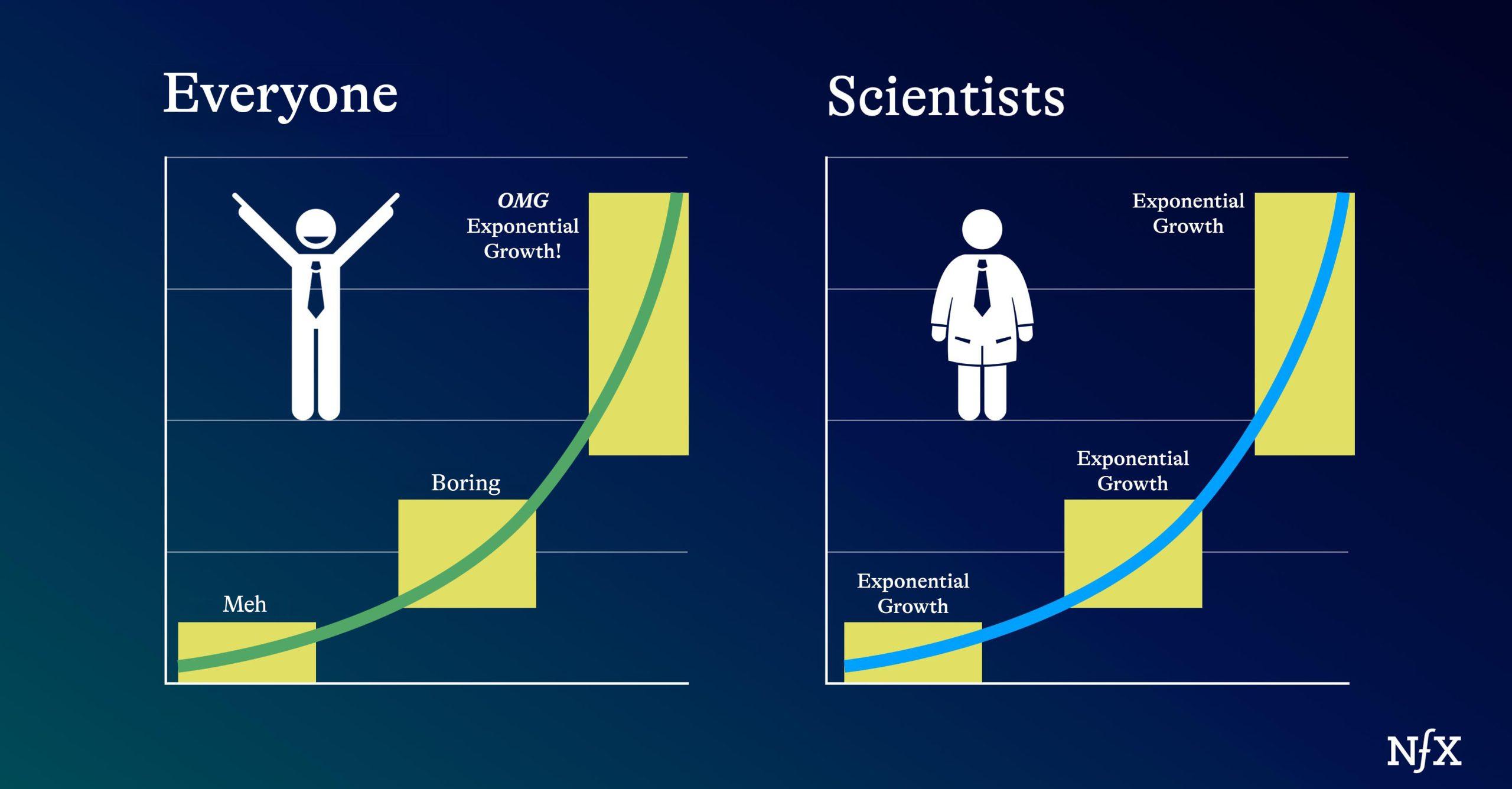
Early-stage venture carries the most risk, but also the highest upside: even the best early-stage investors lose money on more than half their deals, but a handful of companies in every fund can return 50x, 100x, or more. With superintelligence on the horizon, that asymmetry gets steeper, not flatter.
So we need to invest in ideas that feel impossible today. These are the ideas simply waiting to be unlocked by the superintelligent machine. That might feel like irrational boldness. It’s actually the only rational response to what’s coming.
What do we look for? New technologies or business models that turn the world from one state to another — from no smartphones to smartphones, from cancer being largely untreatable to cancer being manageable or curable, from an insufficient energy supply to an endless energy supply.
Superintelligence will turn its sights on many of these problems. They will undergo “the transition.” Each transition is a spike in value creation, and the investors who got in early capture a disproportionate share. The superintelligence wave will roll through the economy, domain by domain, and each domain it touches will undergo its own version of what is happening in coding and legal. But likely bigger.
Right now, we are at the cusp of “the transition” from human intelligence to abundant superintelligence. The time to choose where we aim is now.

What Is Worth Owning?
Here is the fear underneath the question my investor friends are really asking. They don’t doubt the upside en route. What they secretly fear is the end state: that superintelligence will erode the durability and defensibility of everything.
If technology creates abundance, what is worth owning?
Fair question. The answer reveals why venture, done correctly, gets stronger through the transition rather than weaker.
Abundance doesn’t eliminate scarcity, it relocates it. Every prior technology wave has worked this way: when computation became abundant, value moved to software; when software became abundant, value moved to distribution and data; when content became abundant, value moved to curation and attention.
When intelligence becomes abundant, value will move again — to everything intelligence needs but cannot conjure for itself. That list is knowable today:
Networks: When every company has access to the same superintelligent capability, the product is no longer the moat. The network is. Marketplaces, social graphs, protocol standards, multi-sided platforms: these get more defensible as the cost of building everything else falls. Intelligence can clone your features overnight. It cannot clone your users’ relationships with each other. This is why we named our firm NFX: network effects are the most durable defensibility the digital world has produced, and the abundance era will make them more valuable, not less.
Proprietary data and physical-world access: Superintelligence will be bottlenecked by what it can see and touch. Unique datasets — clinical outcomes, biological assays, industrial sensor data — and the physical infrastructure to generate more of them (labs, trials, fleets, factories) are positions that cannot be reasoned into existence. They must be built, and building takes years. This is the logic of our bio and deeptech investing: IP and data moats are claims on the inputs superintelligence will be hungriest for.
Regulatory and institutional position: An FDA approval, a banking license, a defense contract, a hospital system relationship — these are governed by institutions that move at human speed. The companies that hold these positions when superintelligence arrives become the channels through which it reaches the regulated 60% of the economy. Owning the channel matters more when what flows through it becomes infinitely capable.
Trust and brand: In a world where anyone can generate anything, knowing who stands behind a product becomes the scarcest signal of all. Abundant intelligence makes abundant noise; trust is the filter. Trust is built slowly.
The irreducibly human: Even at the end of the story, there will be things that hold unique value precisely because a machine didn’t make them. The hand-forged object made in the old way. Watching an athlete at the peak of human ability compete — after all, computers have been superhuman at chess for decades, and (basically) nobody watches computers play chess. Superintelligence-driven abundance actually raises the price of these things.
So no — superintelligence does not erode the value of everything. It erodes the value of everything undefended, and it concentrates value in the defensibilities above. The discipline of early-stage venture in this era is to invest only where one of these moats exists from day one. That is what we do.
The End State
Ironically, capitalism-funded AI superintelligence could enable the socialist dream: governments providing “free” high standards of living. Superintelligence could, potentially, make everything so cheap and abundant that every citizen can be guaranteed life (healthcare and longevity), liberty (justice and safety), and the pursuit of happiness (free time, the end of drudgery and meaningless work).
To be clear, this isn’t a political program; it’s what happens when the marginal cost of intelligence approaches zero and capital has spent the preceding decades aiming it well.
There are very good reasons to invest as we move towards that end state. The upside en route is enormous. Not to mention that the economics of not investing (i.e. your money losing value every year thanks to inflation or inflationary policy) make the alternative impossible.
Because of this, we don’t fear superintelligence. We embrace it because it will drive returns and make the world better. When AI and robotics make products and services dramatically cheaper and more abundant, life will get better for many people.
But for that to happen, we must invest through the transition, starting now. Investing today is how we aim the superintelligent machine.
Every company we fund is a decision about what superintelligence gets pointed at — what problems get defined as worth solving, what domains get the resources to undergo their transition and in what fashion.
The best way to build a better world — for humanity and for your portfolio — is to invest in the companies building today. The decisions being made today will shape the arc of this century.
Superintelligence is coming. The only question that remains is where we aim it.
And that question still belongs to us.



As Founders ourselves, we respect your time. That’s why we built BriefLink, a new software tool that minimizes the upfront time of getting the VC meeting. Simply tell us about your company in 9 easy questions, and you’ll hear from us if it’s a fit.