
There is only one force that has ever permanently raised human living standards and increased the size of the economic pie: science and technology.
Everything else is redistribution, debt cycles, or borrowing from the future. Technology alone does the impossible: it creates new things and enables us to do more with less.
Think about what that actually means historically. Thousands of years ago, nearly every person alive spent most of their waking hours producing food. Today, a tiny fraction of the population feeds more people than at any point in recorded history. And the hours we used to lose to the fields have been transformed. They became medicine. Engineering. Art and leisure.
Every meaningful wave of technology works this way: it absorbs the drudgery and creates new possibilities. Abundance. That is the real magic.
AI is part of the same pattern. It allows us to do more with less and has great potential to create abundance. It already has in some ways: it’s creating abundant software coding for everyone, for example. But as AI creates abundance in many areas (intelligence, software), it will make it very obvious which areas severely lack abundance. The biggest and most pressing area? Health.
In many ways, the world of health and longevity has lagged behind the rest of the innovation curve. Yes, we have made lots of progress, but a long, healthy life is still far from abundant for most people. It still needs to be unlocked.
One of the major impacts of AI will be to make health and longevity a larger sector of the economy. As everything else is solved, the biggest problems left to solve will increasingly be bio/health problems.
It’s a big idea, but here’s how I think about it.
Technology Creates Abundance
The power of technology is that it allows us to achieve more with less — what economists call productivity growth. This is actually about more than just squeezing efficiency from existing systems. It also unlocks entirely new capabilities that were previously unimaginable. And as a result, the world gets (mostly) better.
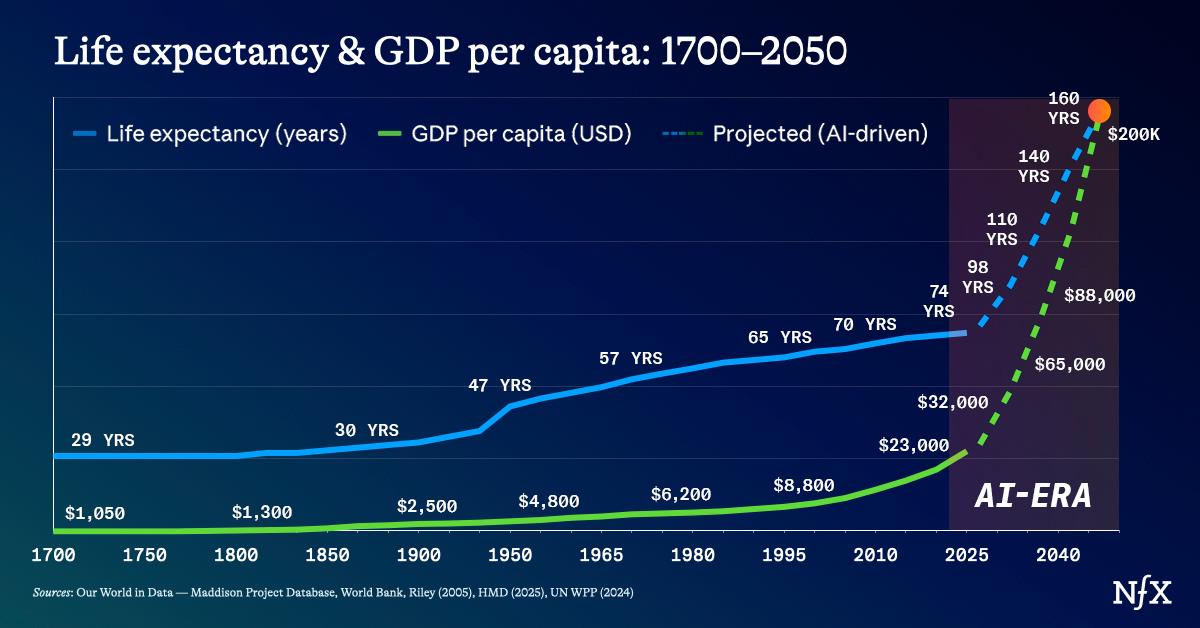
People look fondly on the past. But the past was, by any honest measure, horrible. This chart below tells the truth. In terms of life expectancy, living standard, and wealth, basically nothing happened for thousands of years — and then everything exploded. It began with the Industrial Revolution, but it has really taken off during the Information Revolution.
The power of innovation is that it raises the standard of living over time.
Why does that happen? It’s because technology unlocks far more than simple efficiency. Think of it like a tech tree in Civilization. Pottery unlocks writing. Writing unlocks commerce. Commerce unlocks exploration. You can follow the chain all the way to giant robots — and beyond. That’s just a game, but this principle is very real.
Over time, these innovations compound. New innovations happen, things become cheaper, and life has the potential to get much better.
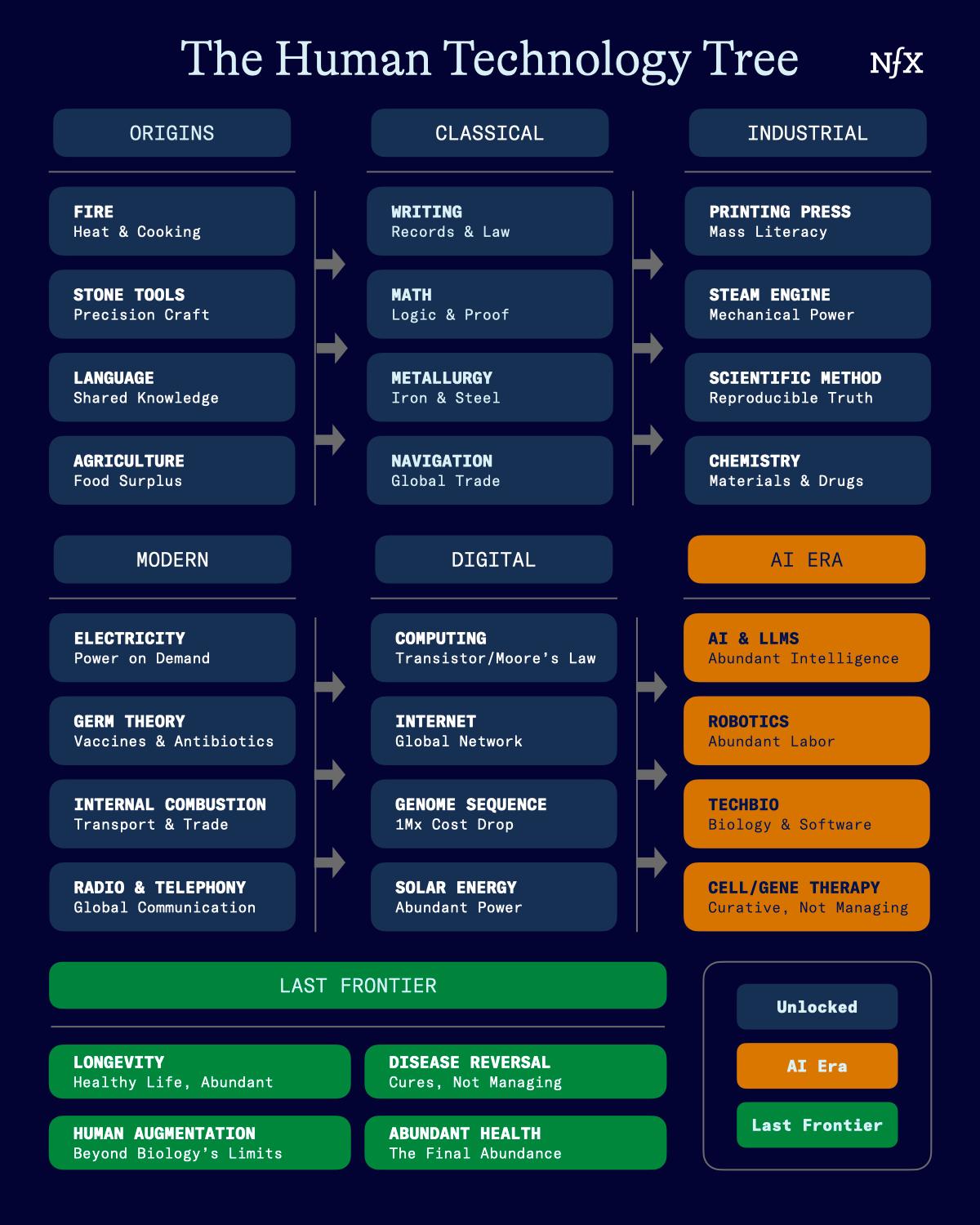
You can see the picture at-large up top, but there are microexamples in your own life right now.
The TV on your wall is one example: The first color televisions in the 1950s ran at more than $10,000 in today’s dollars. And it was all somewhat pointless, because there was basically nothing to watch. Today, flat-screen LCD and OLED televisions are mass-manufactured at global scale. Prices have fallen by over 90 percent since the early 2000s. Your average household has at least one big-screen TV with an endless amount of cheap to free entertainment.
Technology drove down costs — and, in doing so, created an abundance of media, programming, and video games that did not exist before.
The computer on your desk. The phone in your pocket. Those are the other examples each day of how technology and innovation made life better en masse. And there are many examples in biology too, that most people never notice.
Look at monoclonal antibodies. They were first developed in the 1970s as an experimental lab tool. Over the following four decades, advances in cell culture, bioreactors, and antibody engineering turned these bespoke molecules into an industrial platform. Now, more than 100 monoclonal antibody therapies have been approved across cancer, autoimmune disease, cardiovascular disease, and infectious disease.
There are people alive today who would be dead if not for this change. For example, antibodies like trastuzumab for HER2‑positive breast cancer or pembrolizumab for melanoma and lung cancer have measurably improved survival rates. That’s the innovation curve at work.
And then there’s our favorite example: genome sequencing. The cost of sequencing a human genome has dropped 1,000,000x in 25 years. This has made entire categories of companies and treatments possible that were not imaginable even a decade ago.
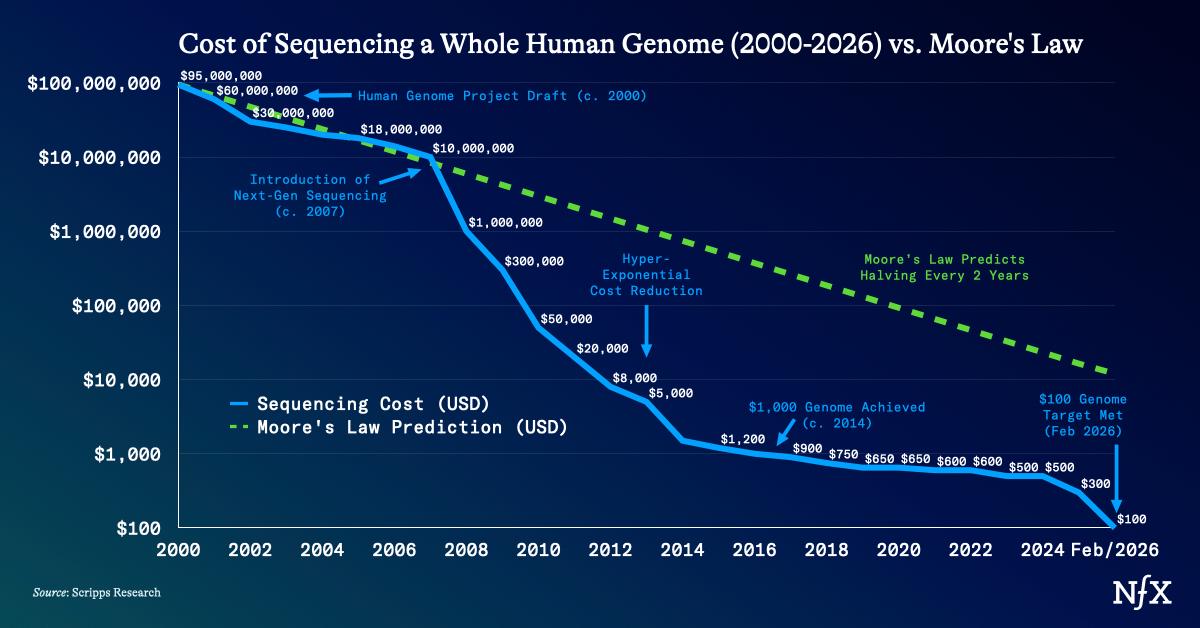
Each time, the pattern is the same: technology first makes something possible. Then, over time, it tends to become cheaper. Abundance is created in both predictable and unpredictable ways. The TV created abundant access to media. The iPhone has created abundant instant communication and access to the accumulated knowledge of humanity. Monoclonal antibodies have literally added years to certain people’s lifespans.
But there is a nuance here. As we travel along this curve of innovation and abundance, we tend to hit asymptotes – moments when experiences or standards become good enough where “premium” isn’t really that much better anymore.
This happened with TVs – is a SUPER big screen reality that much better than a medium-large screen? It happened with Uber rides – if a car comes in 2 minutes as opposed to 4, most users don’t really care. It happened with iPhones: today, rich people use the same iPhones as everyone else.
This is happening with AI models and software products (do you like ChatGPT more because it can score 100% on the SAT compared to 98%?).
This asymptote, or optimization challenge, is very real for many industries as AI takes over. But in biology, we are not going to experience that change for a long time (and when we do, we will all celebrate very happy, long lives!).
Today, in bio, there are still huge problems to solve. We are not even close to optimizing with tiny tweaks. Somewhere, right now, someone is getting a diagnosis that better tools could have caught earlier. Someone is losing a parent to cancer. Someone who could be cured by an existing therapy isn’t getting it because it’s too expensive to make for one person.
In this way, bio has “lagged” behind the rest of the innovation curve. We are not in an optimization phase; we are still solving huge problems.
Warren Buffett famously said, “You can’t make a baby in a month by getting 9 women pregnant.” Read: Some things are just hard and take time. Bio is one of those things. Although we have more biological data today than ever before, there are still huge gaps. Cells, and organisms take time to grow. No matter how smart the AI is, it can’t figure things out without huge investments in data collection and time.
AI will help us. But it’s still hard. And in this case, hard can be a signal that there’s something valuable to achieve.
This means, entrepreneurs, there is a significant opportunity here to build something massive with huge impact.
Biology: The Last Frontier for Abundance
If you break it down, what is really the most important form of abundance? Health. Specifically, healthy time. Would you rather be a rich 80-year-old or a poor 18-year-old?
Creating an “abundance” of healthy time through innovation sounds impossible. But humanity has already achieved it.
Today, your typical American can expect to live into their 80s. But this was far from the case even 50 years ago. While the vast majority of the increase in human lifespans stems from reducing child mortality, even adults have seen significant improvements. Largely, because vaccines, antibiotics, blood pressure drugs, and statins turned once-fatal infections and heart attacks into manageable events.
As a species, humanity has experienced a near-tripling of human lifespan, thanks to technology.
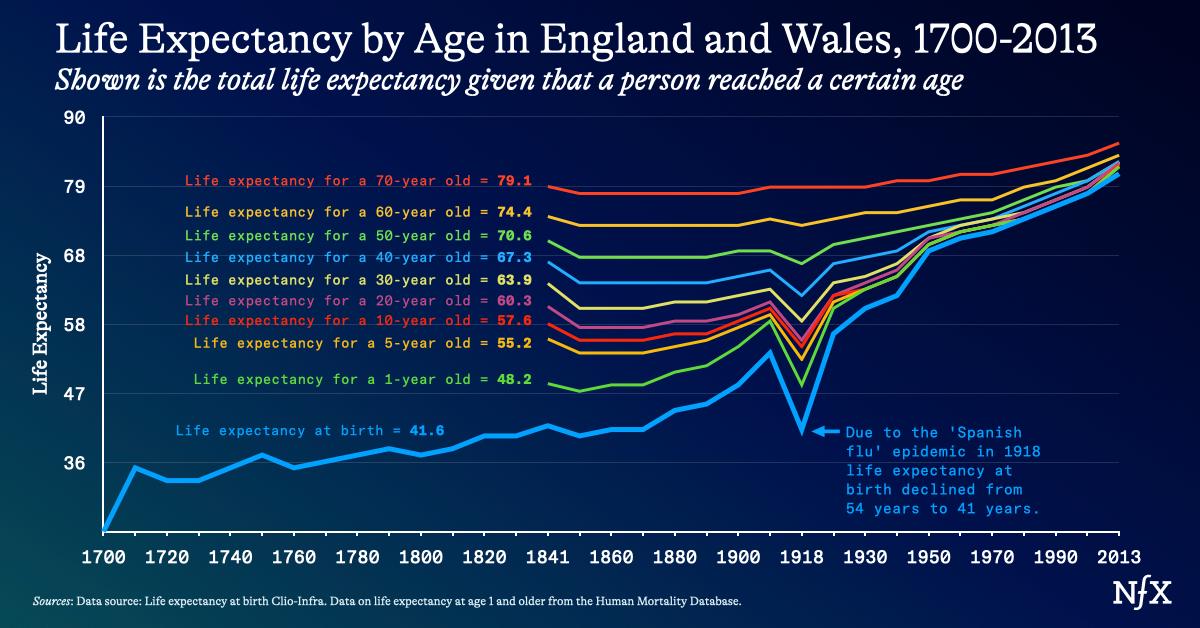
But even today, health is very far from abundant on so many levels.
There are gaps between the rich and the poor. We should use biology and technology to make innovations cheaper, so more people can access them.
Even in rich countries, many people lose the last 20 years of their lives to declining health and the complications of aging. We can make better technologies, so previously incurable things become curable.
The current healthcare paradigm we have rarely keeps people healthy – it’s more about managing illness. It treats death and suffering as inevitable. Maybe we can even keep healthy people healthy, so they never fall sick in the first place.
Things that used to kill millions – like smallpox – are now eradicated. This is a miracle. We can use the magic of technology to make more miracles.
The Curve of Progress in Biology: Theoretical -> Practical -> Scalable
This innovation curve is already working. The same innovation engine that made TVs abundant and phones abundant is being pointed at the hardest problems in human biology.
We are seeing the next generation of therapies emerge, following the curve of human progress from theoretical to practical to scalable.
Here are some examples of technologies that should be unlocked as the progress curve accelerates.
Biologics: Currently, most biologics are still complex, high-cost medicines. But we are seeing many companies innovate on these processes to make them more easily scalable, or even more effective.
Our company, Trojan Bio, for example, is pioneering a new wave of in-vivo (in-patient) CAR-T cell therapy by developing antibodies that target tumor cells and mark them with viral peptides. This allows the patient’s own immune cells, which already know how to kill virus-infected cells, to fight cancer from within.
Another example is our company, Nanocarry. They’re using an insulin-based nanotechnology to finally shepherd biological therapies across the blood-brain barrier.
Companies like this speak to a pattern we hope will accelerate going forward. The ability to create new, complex therapies made from the magic of biology itself, and deliver them where they need to go.
Cell Therapy: Cell therapy is another area where we expect significant changes. These therapies are often potentially curative for certain cancers, but currently cost millions per patient.
ImmuneBridge is one of the companies that we believe will make this therapy scalable. Their platform has the potential to eliminate tradeoffs between cell diversity and scalability – a major bottleneck for this field. Our company, Edity Therapeutics, is taking a different approach to cell therapy: using immune cells as carriers to deliver optimized therapeutic proteins directly to diseased tissues.
Gene therapy: The promise of gene therapy is well known – a one-time cure for genetic diseases. In 2017, we invested in Mammoth Biosciences – a platform for identifying and developing CRISPR-based precision gene editing – because we believed this is a modality that should, one day, become abundant.
These three modalities, made scalable, represent something extraordinary: the practical elimination of many diseases that shorten human life. These are very real directions that we see scientists taking on right now
Talent, Funding, and Innovation Will Flock to the Hard Problems
The software and technology markets are in a kind of vertigo right now, because with rapidly growing intelligence at their disposal, it is genuinely hard to figure out what is worth working on. The easy problems are getting solved fast.
There is a fear for founders and investors that software and other sectors are getting demonetized. (but it’s great for consumers).
As much of the economy is “solved” by AI, the question of curing illness and living longer, healthier lives will loom ever larger. More talent will flock to biology than ever before. It will become the new frontier. People seeking to make an impact while making a fortune can and should test their talent there.
To some extent, this is already happening in AI. If you talk to college students today, the ones interested in technology are focusing on “deep tech” – space, infrastructure, hardware, and robotics. The most ambitious people – the ones we should be funding as investors – always look for the big, hard, life-changing problems. They are drawn to it by nature.
Biology is a massive target today – but it’s going to be even bigger in the future as these other sectors become “solved.”
Many people have already recognized this (we’re funding them!). But we believe many more will realize this soon. It’s just going to become obvious.
With AI’s ability to understand biology, analyze data, reduce risk, and speed up discovery, real solutions — at scale — are becoming possible.
We Want to Make Health Abundant
The real wealth is health. And the real magic of technology is abundance. In the next decade, the biggest problem facing us as a society is how to make a healthy life abundant with the new tools at our disposal.
As AI drives down the cost of tackling difficult biological problems, the standard of living for large portions of humanity can rise. Things that were premium — highly-skilled healthcare, early disease detection, curative therapies — can become increasingly available.
If you, like us, believe a healthy life should be abundant, work with us.



As Founders ourselves, we respect your time. That’s why we built BriefLink, a new software tool that minimizes the upfront time of getting the VC meeting. Simply tell us about your company in 9 easy questions, and you’ll hear from us if it’s a fit.