
NFX FAST, our signature funding competition, is open. Apply Here.
We are no longer deploying software. We are deploying intelligence.
That’s a conviction founders in Israel and Silicon Valley have been operating on for three years – and the rest of the world is only now catching up. AI doesn’t replace software. It replaces the need for it, because it directly does the work.
Yes, this means the old era of software is probably done. The days of building tools for humans to operate, with large teams of mostly human developers, are dated. But the bigger point isn’t what’s ending – it’s what’s beginning.
When intelligence becomes infrastructure, every industry gets rebuilt around autonomous execution. This is creating a massive opportunity.
Here’s how we see it, and what it means for you:
AI is Bigger Than SaaS Ever Was
The last time we saw a shift like this was the internet in the 1990s. Back then, everyone was debating the fate of “internet companies.” Today, no one uses that phrase. As Intel Chairman Andy Grove put it in 1999:
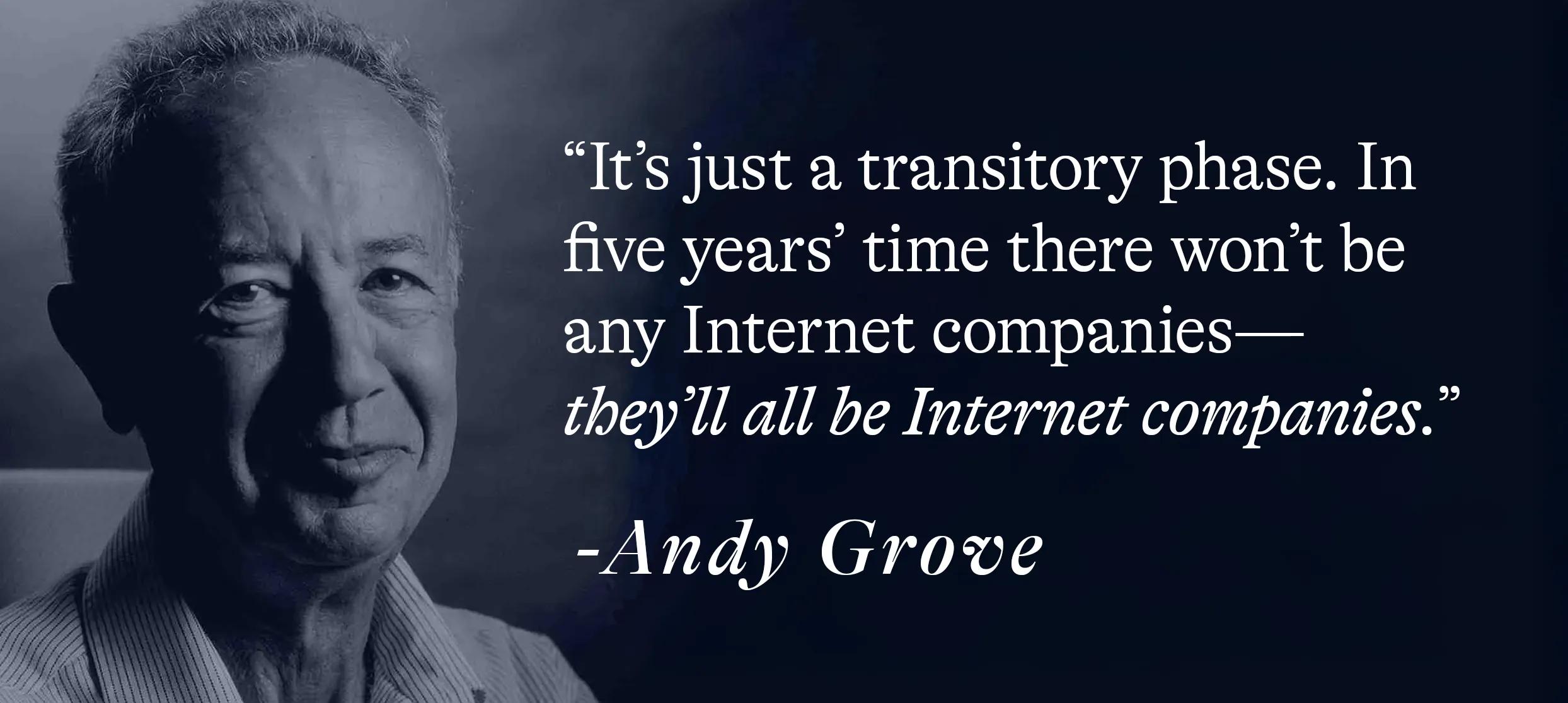
He was right. What was $200-250B of speculative market cap in the 1990s compounded into an infrastructure layer underpinning roughly one-fifth of world GDP by the 2010s. The internet stopped being an industry and became the foundation for everything else.
AI is the same. If the internet is the connector, AI is the doer. We now have an intelligence that works without human intervention – one that can underpin nearly every human activity, from gaming to drug development to running a small business.
This opportunity is vastly larger than SaaS ever was – it’s far more like the early internet.
Here’s a simple way to see why: the best SaaS platform charges $1,000 per person per year. The person using that software earns $100,000 a year. Software was always capturing the value of that tool – but now AI can capture the labor, too. That’s a 100x shift in what’s up for grabs at the individual level.
Now scale that up: SaaS competes for roughly $1 trillion in global software spend. Global labor is a $50-60 trillion market. AI isn’t a marginal expansion of the SaaS opportunity – it’s a completely different game, with stakes 50x larger. When you stop thinking about replacing software and start thinking about replacing work, the ceiling disappears.
And that’s the opportunity.

You Are Ahead of Your Customer
You are likely slightly ahead of your customer. That gap is both your advantage and your challenge.
The public still doesn’t really “get” this new autonomous world. There’s a reason so many AI labs name their products like humans (Claude, Alice, Gemini, Devin). This is to convey that the AI is more than just a tool – it is also the labor.
But the fact that this naming convention exists indicates we are struggling to grasp a significant change, and most people aren’t quite there yet.
This is normal for technology adoption curves. Again, look back to the early internet. In the 1990s, the media relied on analogies such as “the information superhighway” to help people understand that the internet was a transport system for information, not just a toy. Naming AI tools like people is the same – a crutch as we catch up to the new reality that AI is a largely autonomous actor.
And even smart, well-funded founders have been caught out by changes this large. Jasper is a salient example.
In 2022, they were generating $80M in ARR. By 2023 they were projected to hit $140M. But amidst competition from generalist AI platforms, they had to revise those figures – because they had built a tool when the world was moving toward labor. They’ve since pivoted to “putting AI agents to work for marketing.” Notice the autonomous framing.
It’s the right move. But it shows just how quickly you need to adapt to the new reality.
By the time the public fully catches up, you should already be asking the even bigger question: what if AI isn’t just another worker – it is ubiquitous, nearly infinite intelligence?
The Second-Order Effects of Autonomous and Infinitely Customizable Software
For the first time, software can be truly unique – not off-the-shelf, not adapted to fit your workflow, but built around exactly how you think, operate, and see the world. Mickey Haslavsky, founder of NFX-backed Enso, calls this the era of “Custom Autonomous Software.”
Two things led us to this point.
The first is pure economics. In the last year alone, OpenAI’s API token costs fell roughly 90%. Open-source models like Llama, Mistral, and DeepSeek can now run locally. Startups that spent $500K on OpenAI credits last year now spend $50K and get better results.
The second is that the technical understanding required to solve your own problems with bespoke software is no longer necessary. People who don’t “think” in software can begin to create edge-case solutions to their own problems.
The concept sounds abstract until you see what people are actually building. Kevin Roose, a New York Times technology columnist who is not a programmer, used AI to build a suite of personal tools — a podcast transcriber, and social media bookmark organizer. He called these “software for one.”
It sounds modest. But it’s the leading edge of something enormous: more software, more features, more startups, and more ideas are being built and launched today than at any point in history – not just by startups, but by SMBs, consumers, and employees building on their own time.
When every SMB owner, operator, and domain expert can describe what they need and have it built in hours — not months — the old model of buying off-the-shelf SaaS and adapting your workflows to fit it starts to look absurd.
And that creates a second-order opportunity that’s just as large as the first.
What platforms help people create new businesses on the back of this new “software?” Who handles deployment, security, and reliability when millions of non-engineers are shipping constantly? Who builds the discovery layer — the “App Store” for custom autonomous software — where a brilliant workflow built by a dentist in Ohio can find the other 10,000 dentists who need exactly that?
Today, that infrastructure is only starting to emerge. But some companies recognize the scale of these opportunities and are engineering totally new systems to meet those requirements.
For example, our company Enso has built tools that help people build fully agentic businesses without writing a single line of code. They’re turning people who have never thought of running their own business, let alone their own online business, into business owners.
Another example is our company, Koi Security – recently acquired by Palo Alto Networks for $400M. Koi recognized that a world n-of-1, custom software creates far more surface area for potential cyberattacks. They saw this trend long before major cybersecurity incumbents and built the platform to keep that new paradigm secure.
Infinitely customizable software is creating far more opportunities than it’s eliminating. You just have to shift your mindset to see it.

You Must “Break Reality”
Seeing the opportunity is only half the battle. The harder question is: what do you build with it?
There’s a useful way to think about this historically. The first wave of software was about translation – taking analog processes and making them digital. Amazon was an online bookstore. TurboTax was online tax filing. The edge was distribution and lower costs, not a fundamentally different vision of the world.
The second wave was about creation – building things that couldn’t exist in the analog world. Facebook, Instagram, Lyft. These weren’t translations of existing behavior, they were new categories entirely. Instagram didn’t digitize photo albums – it invented the creator economy. Lyft didn’t digitize taxis – it turned anyone with a car into a driver and doubled the number of trips taken in New York City in the last decade.
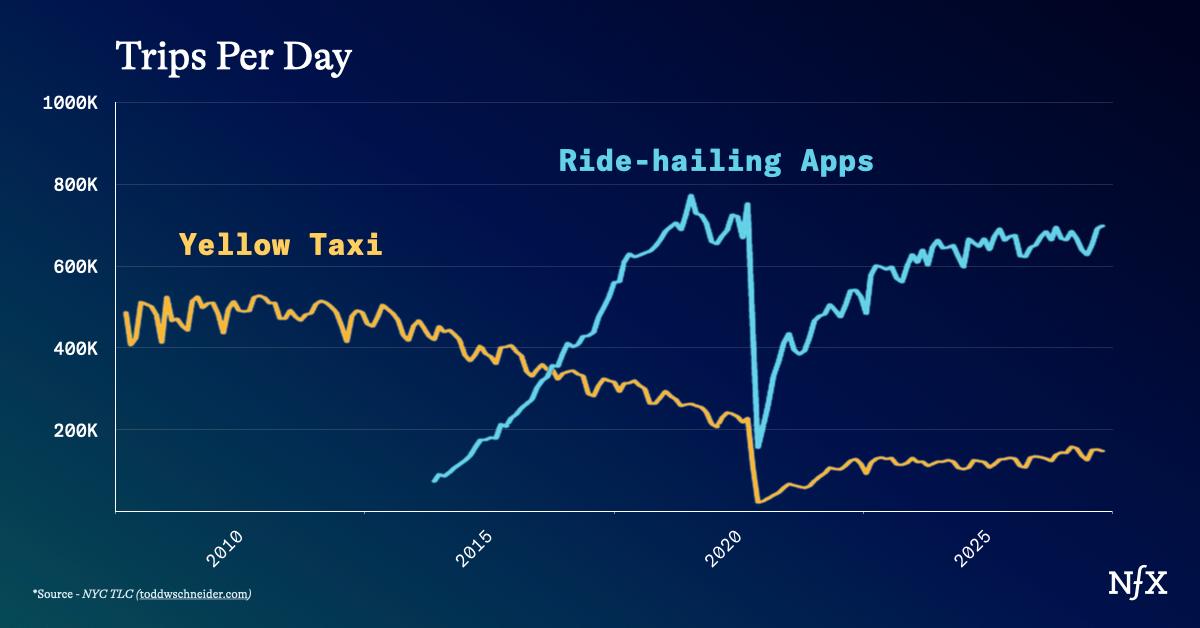
The best of these companies shared one thing: they rejected the rules of the existing world. Who says you need to be a cab driver to drive a taxi? Who says you need a storefront to be a retailer? Shopify grew from facilitating $61B in sales in 2019 to $292B in 2024, mostly by turning people who had never thought of themselves as merchants into merchants.
And that created second-order markets of its own. For example, our company Triple Whale has created a complete e-commerce analytics platform for companies like these, that couldn’t have existed before the consumer e-commerce revolution.
As an aside, if a storefront could create that potential, imagine what a fully automated business plus a storefront like this could create? That’s why Triple Whale is now adding the agentic layer that does the actual work for their customers instead of just enabling it.
We are now in the third wave. And the blank canvas is back.
With AI, everyone has the team. Everyone has the technical ability. The constraint is no longer resources or engineering – it’s vision. What everyone lacks is a strong enough point of view on what should exist. The drive and willingness to break reality.
That’s the edge today. Not access to capital, not access to talent, not access to technology. All of that is becoming commoditized. The rarest thing in this new era is a founder who can see what the world should look like and has the conviction to build toward it before anyone else can see it.

The Exciting and Honest Part
The most exciting part: no one really knows where the biggest upside of this new paradigm will materialize.
We can see the patterns. Custom autonomous software. Cybersecurity for a world of infinite custom code. Techbio. Agentic AI that turns consumers into business owners and business owners into enterprise owners. These are real and large opportunities.
But the most honest thing we can say is that the most exciting companies of this era have probably not been built yet. The category-defining products – the ones that will look obvious in hindsight – are still in the minds of founders who haven’t launched yet, or who are a single insight away from seeing something others do not.
That’s what makes this moment different from every other moment in software history.
The blank canvas is bigger than it’s ever been. The tools are cheaper, the leverage is greater, and the ceiling has disappeared.
Shifts like this are where the most important companies get built. Not by people waiting for clarity, but by people willing to remake reality from opportunity.
Now go do it.


As Founders ourselves, we respect your time. That’s why we built BriefLink, a new software tool that minimizes the upfront time of getting the VC meeting. Simply tell us about your company in 9 easy questions, and you’ll hear from us if it’s a fit.