
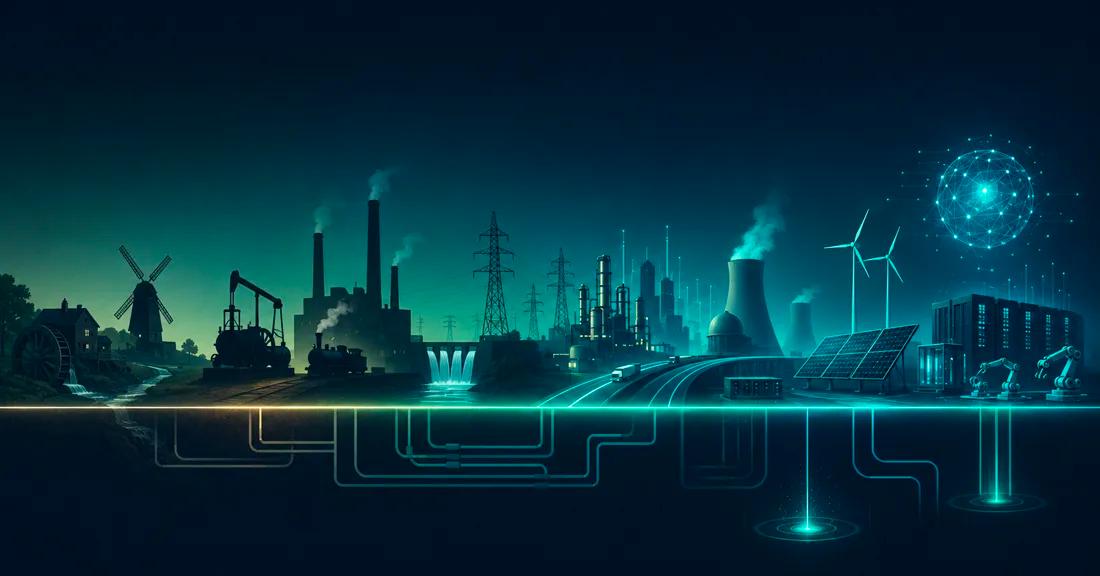
The first industrial revolution was powered by steam – the coal-powered steam engine turned mechanical energy into an abundant resource. The digital era was a revolution in connectivity; it made information more abundant, prompting a new wave of creativity.
AI is an intelligence revolution. It is projected to achieve human-level intelligence and then surpass it. It should have the potential to significantly raise the standard of living, as past revolutions did.
But there’s a problem: this intelligence is trapped.
Insufficient industrial infrastructure and physical limitations are threatening to keep AI’s potential chained. To truly unlock the intelligence revolution, we need to rethink our approach to industrialization, from power to infrastructure, to physical AI.
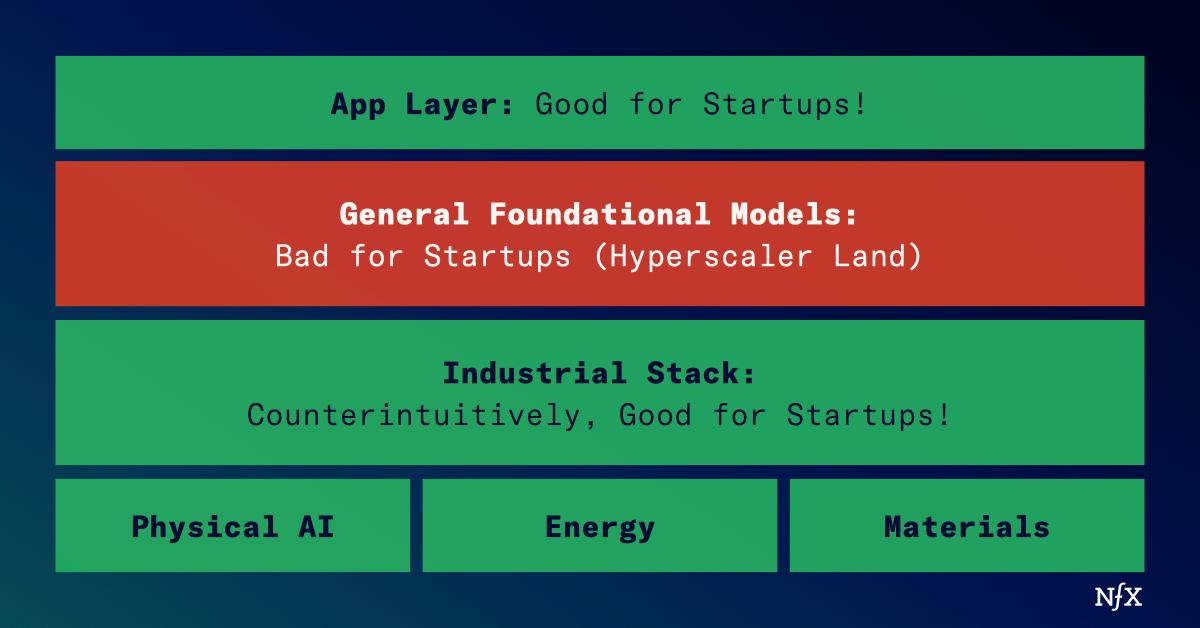
Counterintuitively, this has created great potential for startups. Rather than competing with hyperscalers at the model level, they’re going one step beneath: rethinking the power and materials required by the frontier labs themselves.
It’s kind of genius: The hyperscalers are willing to spend unprecedented amounts to unleash their intelligence. Rather than competing with that distribution advantage, startups can benefit from rebuilding the industrial stack to meet the new (and growing) demand for power and materials.
Why Is Intelligence Trapped?
To produce meaningful change in human living standards, you need three inputs: Power + intelligence + coordinated action.
Let’s use the first industrial revolution as an example. Before the 1760s, economists estimate that there was virtually no true economic growth for over 800 years. That’s not because of a lack of technology. The printing press – the most influential knowledge distribution system before the internet – was invented in the 1440s. Wind and water mills – methods to harness natural energy – had existed since medieval times.
And yet, no accelerating GDP growth curve until the late 18th century.
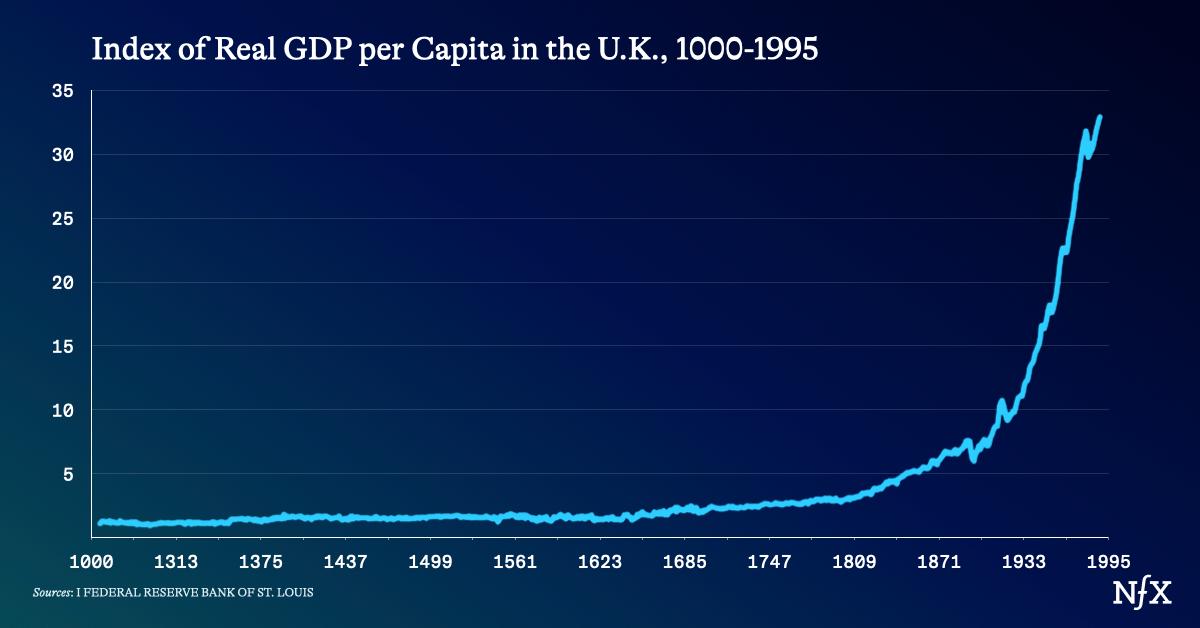
So why no growth? The contemporary thinker and writer Thomas Malthus believed that increases in output from these disparate technologies were offset by population growth. We could never produce more than humanity would consume, keeping us at subsistence levels.
There are many takes on what broke us out of the trap, but one is especially relevant to today: it was not a lack of innovation but a lack of coordination. What eventually broke the Malthusian trap was not a single invention, but the alignment of power, intelligence, and coordinated action into scalable systems.
Let’s look at this piece by piece.
First, power. In 1769, James Watt patented the steam engine. This changed how power could be applied. Before steam, a textile mill had to sit next to a fast-moving river. After steam, factories could be built in cities, closer to labor and markets. And, it became economically viable to run machinery continuously.
But power without innovation is just potential. Which brings us to the second piece: intelligence.
With the power supply unlocked, there was rapid concurrent innovation in the weaving industry. The spinning jenny gave way to the water frame, and then finally to the mechanized power loom. Technology evolved to use the new underlying power supply, increasing productivity per worker.
Now there was new technology and enough power to sustain it. This created the third necessary change: the re-organization of labor, or as we call it, “coordinated action.”
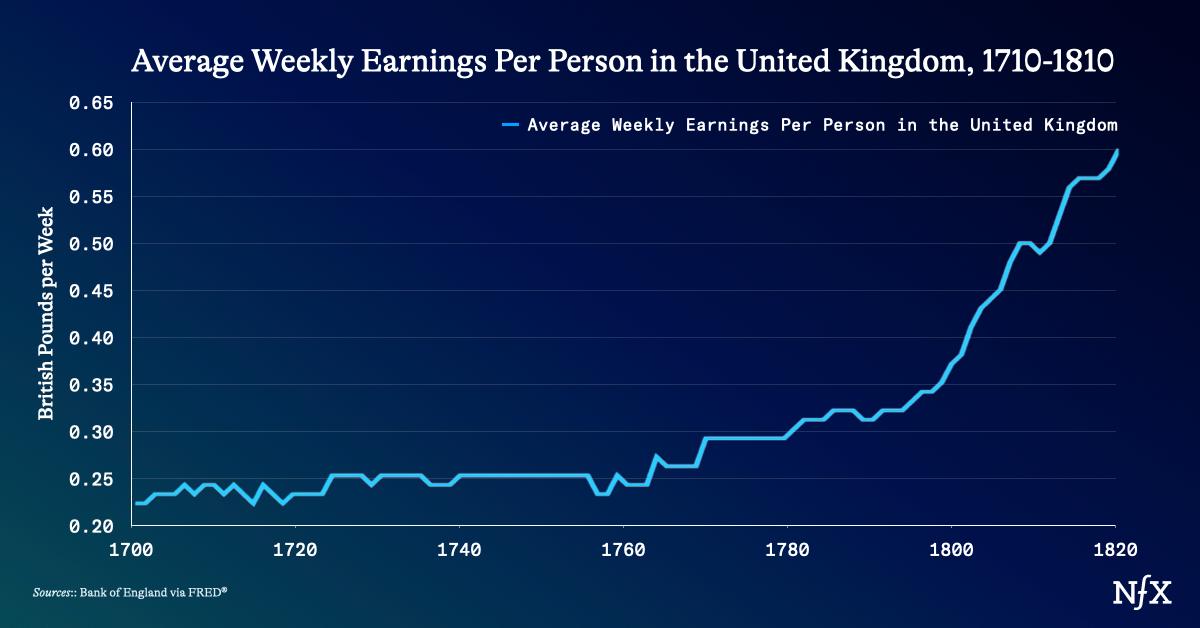
Shortly after patenting the water frame (a precursor to the power loom), Richard Arkwright created the factory model to standardize output and increase productivity. The sheer size and productivity of these new technologies demanded a reorganization of how work itself was done.
The creation of the factory increased productivity, but it also created massive second and third-order effects: the rise of urbanization (which accelerated knowledge sharing), and an increased standard of living.
Power + Intelligence + Coordinated Action. That’s the formula.
Power makes things possible. Intelligence directs that work toward valuable outcomes. Action is what executes at a previously unimaginable scale.
And here lies the problem with AI today. In America, we have the intelligence. But we are sorely lacking in power and action.
To realize the full potential of what AI makes possible, we need two things:
- Rebuild and modernize the infrastructure that connects atoms to bits.
- Create new forms of coordinated, physical action.
The First Opportunity: Power
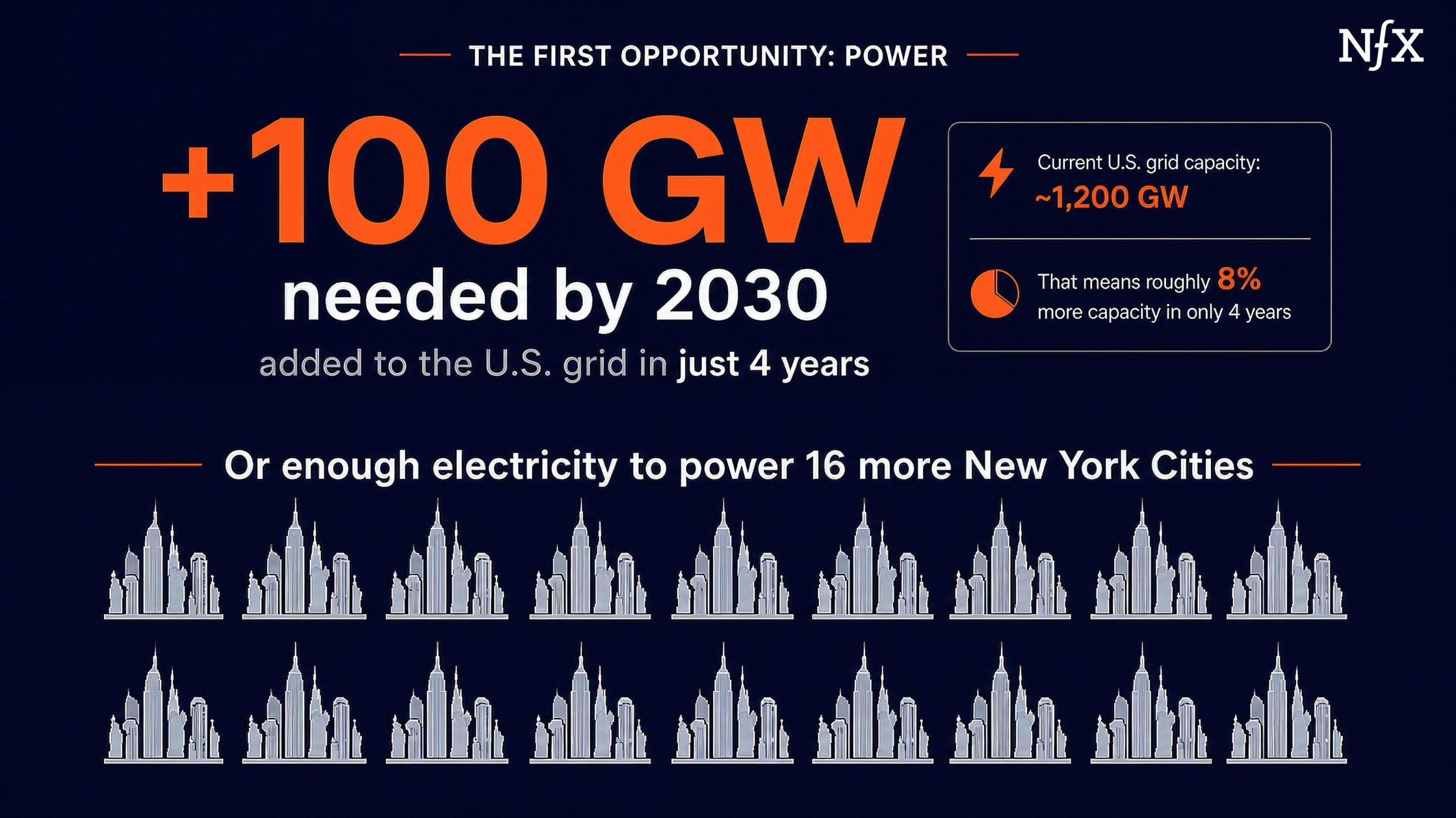
The demand for power is overwhelming. It took centuries to reach our current capacity of ~1,200 GW. But we need more. The DOE has estimated that we need to add 100 more GW of capacity to the current grid by 2030. (For context, that’s enough time to go back to the future 91.17 times, or power ~16 more New York Cities).
The vast majority of that need is driven by data centers.
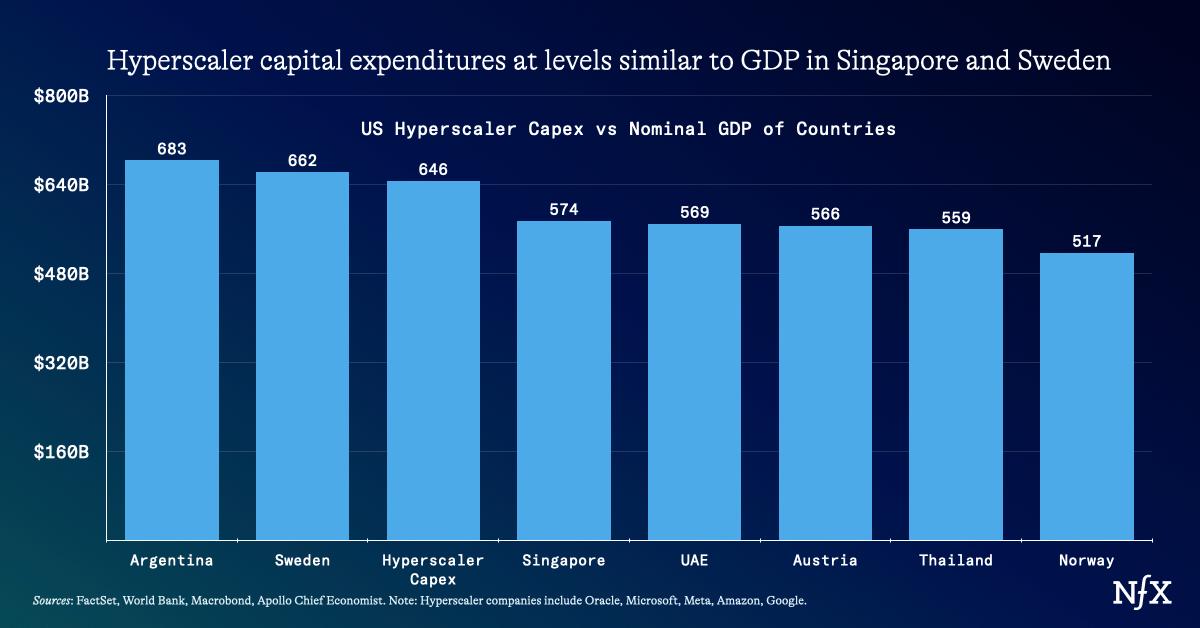
The Oracle, Microsoft, Meta, Amazon, and Google are slated to invest up to $700 billion in US-based data centers in 2026 alone (they’ve already spent $646 billion). That’s not even counting OpenAI or Anthropic – who are increasingly showing hyperscaler ambitions and behavior, from building data centers to leasing capacity – Anthropic and OpenAI are both getting into the data center leasing game as of June 2026.
So an ambitious founder might ask themselves: what’s holding back the data centers, and can startups address this enormous demand?
First, there’s the construction of the data centers. Honestly, as a seed-stage company, you’re not likely to get into the data center construction game (but if you have an angle into that, reach out to us). That said, we’ve seen very interesting companies get into the materials space – more on this in a bit.
Second, there’s the land on which data centers are built. It’s a real constraint. So much so that it’s increasingly appealing to just put them in space. Our company Starcloud saw this opportunity – they’ve had a record year and now sit at a valuation north of $1B.
Third, there’s the thing that the data centers themselves run on, and that’s power.
Before we get into this more deeply, some terminology. There’s a difference between power and energy. Energy is the total capacity to do work. Power is the rate at which energy is transferred, used, or generated.
The immediate issue for the hyperscalers is power – we need to use our current capacity more effectively. The longer-term issue is energy – we need more capacity to do work.
This is causing two reactions:
- Hyperscalers are showing extreme interest in purchasing power as they continue to fight for dominance. (Microsoft has signed a deal to reopen Three Mile Island. Amazon contracted directly with a nuclear plant in Pennsylvania. Meta has issued an RFP to identify nuclear energy developers.
- They’re also investing in bigger moonshots related to energy (fusion, scalable geothermal, SMRs).
So, can startups really play at the power level? Yes. This problem has simply become so large and so immediately dire. The same demand shock that’s straining the grid is creating openings for venture-scale companies at every layer – from squeezing more out of existing infrastructure to building entirely new supply.
This strategy creates several layers of opportunity for founders in the short, medium, and long-term. The first two largely deal with power delivery. The third deals with energy supply.
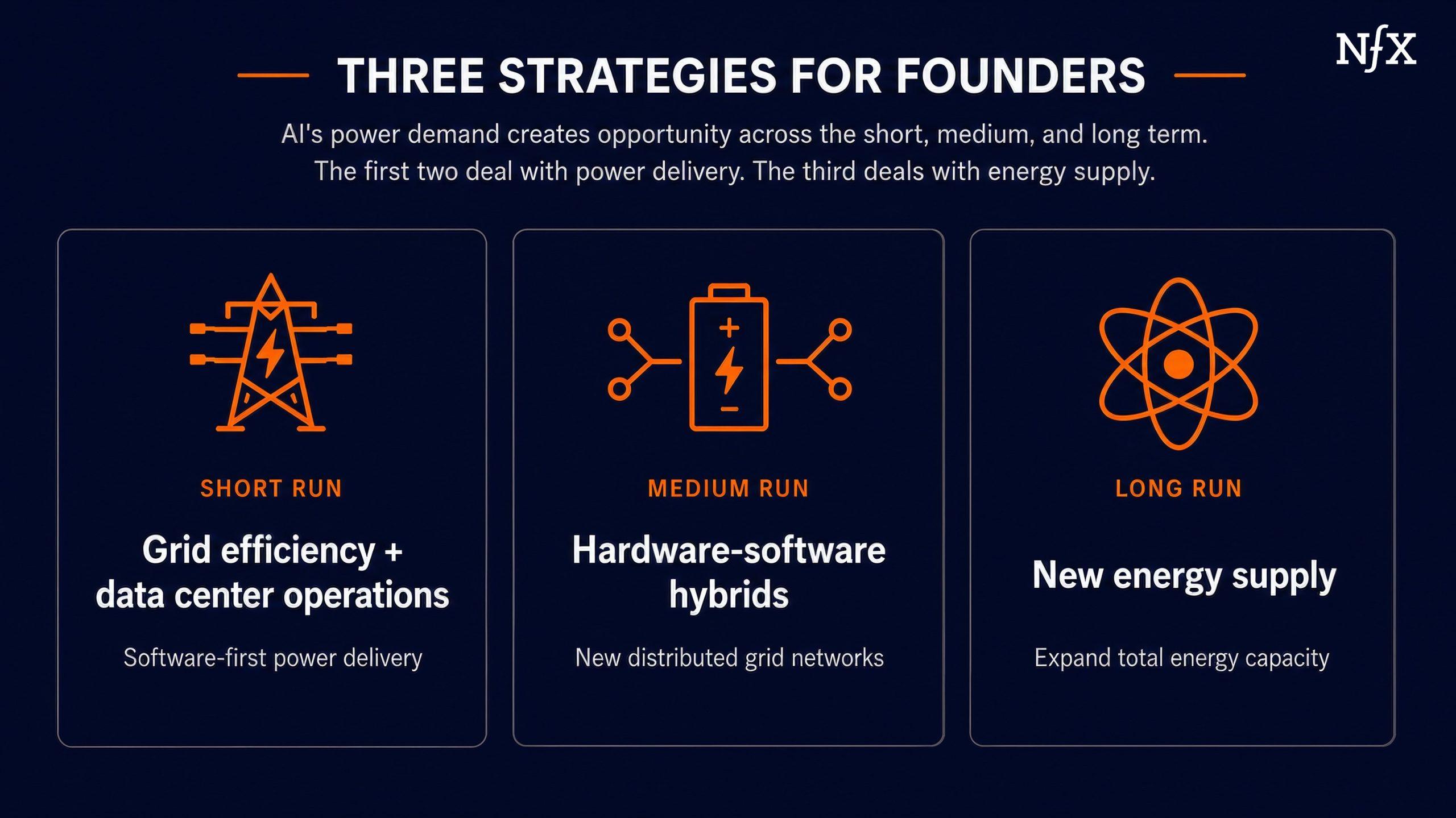
The Short Run: Grid efficiency + data center operations
The first company shape we’re seeing is a software-first approach to increasing grid efficiency.
For most of the year, the power grid only operates at about 50% of its capacity. This is intentional to handle peak load times. However, there’s a developing opportunity to utilize untrapped grid capacity strategically, not just when conditions demand it. Strategic grid utilization could save existing power suppliers about $170 billion over the next ten years simply by developing more intelligent systems to use existing grid resources.
Companies like Gridcare.ai, which uses AI to identify and unlock grid capacity, or GridBeyond, which stitches together disparate grid assets like a virtual power plant, represent the short-term relief valve.
Those are just two examples, but more broadly, we are also seeing an uptick in investment in companies that can extract more power from the existing grid. This is just a signal of how urgent this layer has become in the near term.
The Medium Run: Hardware-software hybrids create new networks
The second company shape we’re seeing is a software-hardware hybrid approach. These companies typically offer some type of new hardware innovation related to power storage (new battery systems), or distribution, and use software to allocate that power more intelligently.
A well-known example is Base Power, currently raising at a $12 billion valuation. Base Power builds fleets of home batteries leased to homeowners. They charge them when electricity is cheap and draw on them on when it’s expensive. The fleet becomes a distributed, privatized grid — and Base Power makes its software available to utilities as well.
Similar logic applies to companies like Exowatt, which builds modular solar units that create a distributed on-site power supply.
This shape basically boils down to intelligent energy storage and redistribution using both software and hardware.
The Long-Run: Increasing supply
There are already well-established approaches to broadening the power supply (traditional nuclear comes to mind). What’s changing now is there’s a new generation of companies that are taking up the mantle of developing and commercializing these technologies.
Three very prominent examples are SMRs, geothermal, and (further out) fusion.
SMRs — small modular fission reactors — can be deployed near data centers, breaking the dependence on centralized generation and long-distance transmission.
There is clear SMR demand. Google has already signed a power purchase agreement with SMR company Kairos Power. And a new cohort of startups backed by big tech is pursuing SMR opportunities. Here’s the list, from TechCrunch.
There’s also clear room for a scale-up in Geothermal energy production.
At the moment, geothermal energy sources are constrained due to site-specific geology. This leads to largely regional power sources – great in the short run but not scalable, especially now, with demand rising so high. Companies like Fervo ($14B market cap) are tackling these constraints through modernizing drilling, sensing, and reservoir engineering to expand the potentially viable geothermal sites. Hyperscalers have already shown interest in this approach – Google both invested in Fervo’s December 2025 round and has a contract to purchase power for data centers.
There’s even some interest in far more radical geothermal projects. For example, in 2025, ARPA-E committed $30M to increase geothermal power production by tapping into reservoirs with incredibly high temperatures and pressures (375 °C and pressures greater than 22 megapascals). In these conditions, water is a supercritical fluid, somewhere between a liquid and gas, but not quite a solid). Put simply, it stores vastly more energy than traditional geothermal energy.
This is extremely new…ARPA-E aims to enable innovations that can withstand those conditions and enable an additional 10-20 GW of baseload power.
Further out — on a 2040-to-2070 horizon — is fusion. Don’t worry, it’s only about 30 years away! Fusion has its skeptics and its challenges. But incentives are truly aligning in its direction.
The demand for fusion has never been greater. Microsoft has signed a power purchase agreement with current leader Helion. Sam Altman has invested personally. Dozens of fusion startups have now raised over $100M.
The government is also sending strong interest signals. In April 2026, ARPA-E committed $135M to develop and commercialize fusion – the largest commitment in the agency’s history.
Fusion is the moonshot: still deeply experimental, still without a commercial milestone, but potentially the long-term differentiating technology that changes everything.
The Second Opportunity: Action
Energy powers intelligence. But intelligence still needs hands.
In the digital world, AI’s action-takers are agents. They can decide, draft, and transact without actually touching anything physical.
To create wide-scale industrial change – the type needed to unlock the new industrial revolution – action can’t be confined to the digital world. The physical world runs on atoms, not bits. AI’s impact will always be constrained unless we develop physical action-takers, such as robots, autonomous vehicles, or even new forms of industrial machinery.
Developing methods to bring AI into the real world has been a tall order for decades. But there are three tailwinds that make now a particularly good time to invest in this space.
- The economic incentive has never been larger. Tens of billions are pouring into raw AI intelligence each year. We have argued before that the TAM of AI is not just software, it’s labor. Right now, with AI confined to the digital world, labor TAM is knowledge work, but trillions are still spent annually on physical work: manufacturing, logistics, construction, and agriculture.
- The talent has migrated. Robotics and physical AI are where the most ambitious young researchers now want to be. The prestige that flowed toward software is shifting toward embodiment.
We see two clear lanes of opportunity for founders interested in physical AI:
1) The horizontal play: tools that power the revolution.
In the same way GitHub, Twilio, and Stripe powered the SaaS wave, a new layer of DevOps infrastructure is forming for physical AI.
The most pressing need is training data. Today’s language models were trained on billions of words from the internet. But it’s not feasible for a robot to perform billions of physical actions. Synthetic data and digital twins — virtual factories where models can learn from millions of simulated interactions — are likely a necessary part of the stack.
There are many new approaches to this data constraint. But here are two flavors:
Human Archive is attaching cameras to gig workers to capture video of humans doing everyday tasks — loading trucks, stacking shelves, navigating warehouses — so that robots can learn from them.
Antioch is developing a tool for building physical space simulations for robot developers. Basically a low-code way to build your own virtual space and teach a robot how to behave.
The goal here is to act as a service provider to the next generation of physical AI companies.
2) The vertical play: owning the full stack in a constrained, high-value environment.
It’s unlikely that one or two large companies will be able to dominate every use case for physical AI. The specificity of certain tasks and industries is simply too complex.
Most people underestimate the TAM of vertical markets, and generalist tools are good for everyone, great for no one. That’s a huge opportunity for startups. We’ve seen a version of this play out in the digital AI world. EvenUp has a $2B+ valuation in the legal AI space because they serve the personal injury law vertical better than horizontal “legal AI.”
We can also apply this verticalization formula to physical AI:
- Find an environment that is physically constrained and economically valuable.
- Find a physical substrate that already exists and is reasonably standardized (or if it doesn’t exist and you understand the space well enough to build it, do it).
- Then build the “brain” tuned precisely to that environment’s physics, safety constraints, and workflows.
There are flavors of this approach in the wild right now. Carbon Robotics runs AI-powered weeding robots through agricultural fields. Dexterity is building full-stack physical AI with an initial focus on logistics. The early winners here will look narrow and specialized, but these use cases are far deeper than most believe.
The Substrate Underneath: Materials
Power and action are the two bottlenecks the equation names. But underneath both of them is something more basic: the raw materials required to build the infrastructure that carries them.
Steel manufacturing is a clear example. Data centers are driving unprecedented demand for steel. Microsoft has already signed green steel supply agreements in Sweden specifically for data center construction. NFX has recently invested in Bethlehem Steel — a new commitment to rebuilding American steel with the speed and operational ethos of a technology company.
This company “shape” – remaking old industrial processes in the image of a new-age vertically-integrated technology company also exists in the mining industry (Mariana Minerals), and the carbon fiber manufacturing space (Helicon Industries). It’s an approach we expect to see more and more.
The same logic applies to many other materials that will soon become essential for the next industrial revolution. Periodic Labs, for example, is working to identify superconductors – materials that can carry electric current without energy being lost to heat. (Historically only possible at very low temperatures. Their approach is to automate materials design to approach this problem from a new angle.
The combination — old industry, constrained supply, surging demand — is exactly the setup that rewards new entrants willing to build differently.
A Higher Calling
What makes this industrial revolution different from the last one is not just the scale of the technological change. It’s who is building it, and why.
The founders working on energy infrastructure, physical AI, and industrial materials tend to have a very grand vision. It’s warranted: With scalable intelligence, many of humanity’s most stubborn problems move from “probably unsolvable in our lifetime” to “hard engineering problems with a path forward.”
Of course, they know the size of this opportunity is enormous. The current level of Capex spending by hyperscalers exceeds the GDP of Singapore, the UAE, Norway, and Sweden. $646B as of February of this year. That’s not a projection, that’s just where we are right now. This will only grow in the future.
With strong economic and moral incentives at play, we are seeing a renewed vigor among founders.
We are at another point at which the curve can go exponential. Energy, intelligence, and action, all converging at the same moment. But two of the three pillars are not built yet.
That’s where we want to invest. And it’s where the best founders are already working.




As Founders ourselves, we respect your time. That’s why we built BriefLink, a new software tool that minimizes the upfront time of getting the VC meeting. Simply tell us about your company in 9 easy questions, and you’ll hear from us if it’s a fit.