
You just got a promotion. It feels like a crisis.
A few months ago, I gave the graduation speech to Tel Aviv University’s MBA class. Twenty-five years of building and investing in companies, and it was the first time I’ve stood in front of a room that talented and seen that much uncertainty about their own futures. I couldn’t blame them. Even Sam Altman doesn’t know what the next five years look like. Let alone the graduate sitting in the third row.
Here’s what I told them. You are living through a shift from execution to direction — from doing the work to defining the problem, choosing the goal, owning the outcome.
Strip away the AI headlines, and that concept already has a name. It’s a promotion. Probably the biggest one in history, handed to an entire generation at once.
Why does a promotion feel like a layoff? Because it strips away the safety net most careers relied on, and it rewrites how you measure yourself.
Great founders have always built without that net. Now everyone else has to learn how.
This Isn’t the First Time a Machine Changed a Job. It’s the First Time It Changed Many at Once.
Automation has erased entire professions before. NASA once employed rooms full of human “computers” — the mathematicians, many of them women, who calculated rocket trajectories and reentry angles by hand. In 1958, Langley installed its first electronic computers, and within months most of that work was gone.
That’s not new. Technology has altered and reinvented professions for decades. So why does this feel new?
First, we are not building a tool that amplifies our capabilities. We are building a technology capable of performing more and more of the activities we once thought were the core of human intelligence. Having a computer do calculations is one thing. Having it do that, write poetry, and have a conversation with a customer is another.
And to add to that, it’s happening all at once.
The Washington Post recently mapped AI exposure across more than 350 occupations and found 37.1 million U.S. workers are in jobs with the highest exposure to it. Interestingly, those jobs aren’t clustered in one industry. They’re writers, programmers, designers, marketers, financial analysts, customer service reps, translators. Unrelated professions, hit by the same wave.
It feels bigger because AI is more powerful than many tools we’ve developed in the past. And because everyone is grappling with this at once. Which means you are all asking the same question:
If a machine can now do a great deal of knowledge work, what’s left?
What’s left is “the deciding”: what problem is worth solving, what’s true, who to trust, who to lead.
That’s not a smaller job than the one you had. It’s a much bigger one, without a safety net.
In fact, it’s just like founding a startup. Today, you don’t just do a job, you create it.
Effort Was Never Enough
We write often about how hard it is to start a company. You have to grind. But grinding was never the hard part — plenty of great founders want to grind.
The hard part was always knowing that grinding alone wasn’t enough. Great outcomes come from experiments, repetition, judgment, timing, and luck, and most people never fully accept that. It’s similar to why many people don’t get how venture returns actually work: a tiny fraction of every fund drives the entire outcome, because investing runs on a power law, not a straight line.
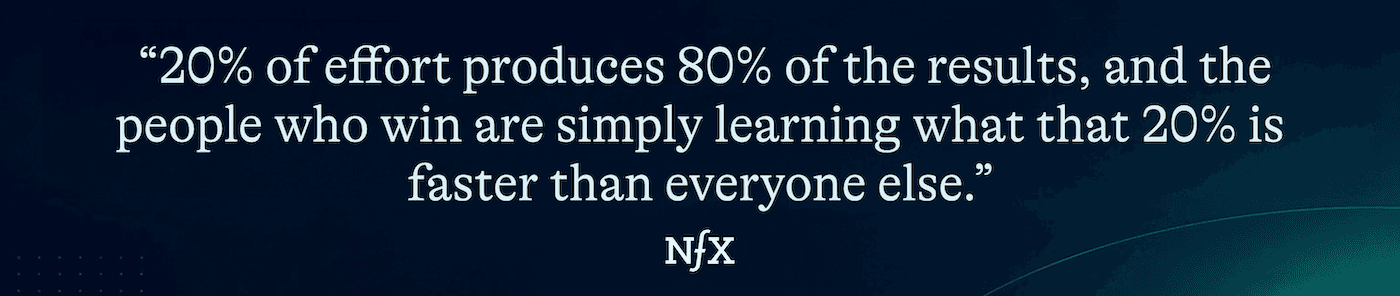
We expect effort in, result out, one for one. The Pareto principle is the better model: 20% of effort produces 80% of the results, and the people who win are simply learning what that 20% is faster than everyone else.
AI ends the effort-in, effort-out argument for good, because it grinds better than any human ever could. It crunches numbers in seconds, drafts thousands of words instantly, builds a working site in two minutes. The output is often rough. It doesn’t matter — it has already eroded the market value of effort by itself.
Before AI, you could get ahead by writing fast, coding fast, producing a lot, and feeling competent because of the volume alone. You’d never become exceptional that way — you still needed people to love the product, still needed a real outcome from all that effort — but you could feel busy, and busy felt like progress.
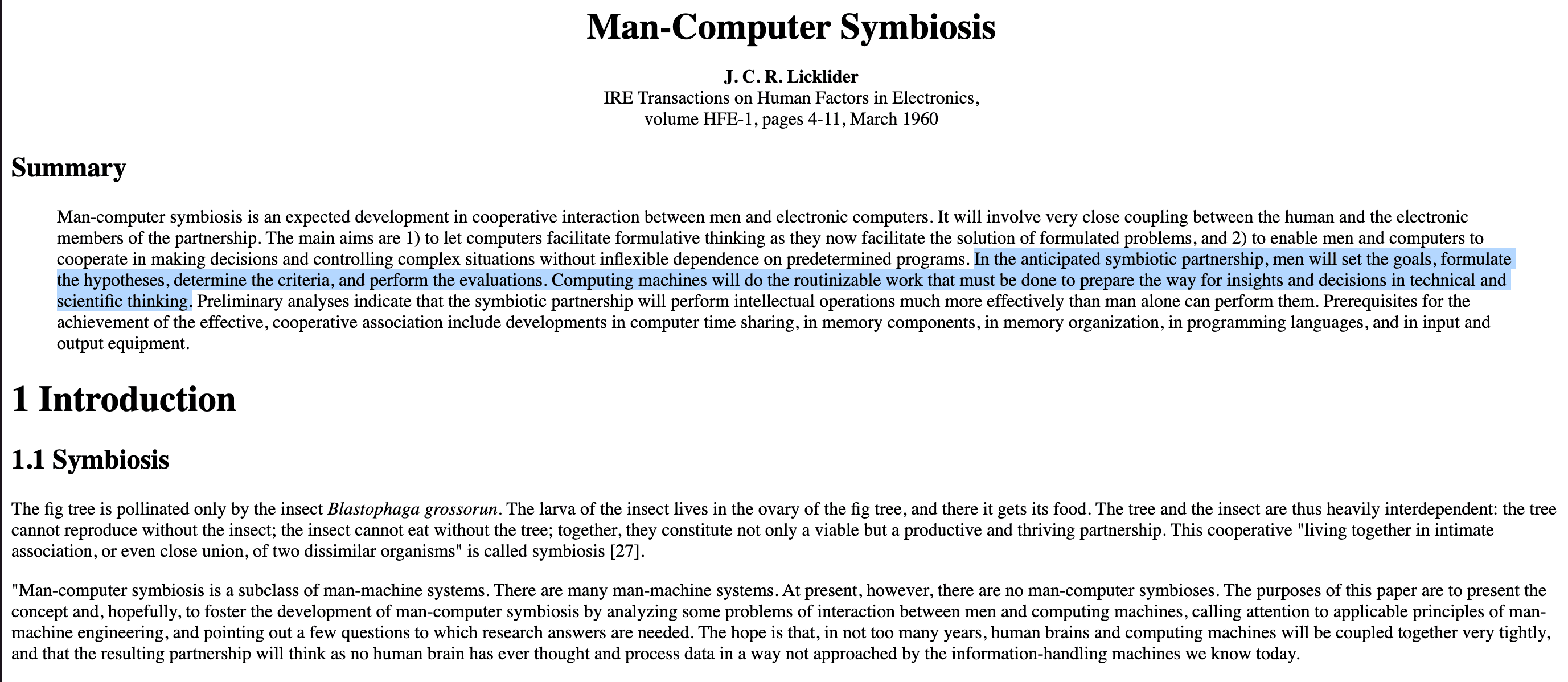
But this was always a false narrative. Computer scientists have known this for literally decades. In 1957, psychologist and computer science visionary J.C.R. Licklider tracked every task in his own workday as an experiment to see how much of his own knowledge work could be easily automated. He found that 85% went to searching for information, reformatting it, and clerical prep—just to clear the runway for original thought.
Only 15% was the thinking that actually mattered.
This concept is an illustrative point in his famous paper Man-Computer Symbiosis, where he argues that the most valuable role for computers would not be to replace human judgment, but to take over the rote, time-consuming work of gathering, organizing, calculating, and presenting information—leaving people free to set goals, make decisions, and generate new ideas
We are living through this transition.
You used to get ahead by clearing the 85% fast. AI just took that job. The only real estate that matters most today is the 15%. (It was always that way, but now it’s clear for everyone to see.)
You Don’t Get to Ease Into the 15%. You’re Starting There.
People who start companies commit to tackling that 15% and owning the outcome.
Today, you have to take it on from day one instead of earning your way there over a decade. You have to adopt the founder mindset earlier and faster.
That makes you exposed. If something doesn’t work, the answer is rarely that you didn’t try hard enough. It’s that you made the wrong call — about taste, about which problem to pick, about vision. Those questions are much harder to answer than “did I put in the hours?”
That’s likely why we’re seeing a cultural resurgence of performative work — the 9-9-6 schedule, tokenmaxxing, or hours logged as a personality trait. People are reaching for ways to measure their worth instead of accepting that those measurements stopped working when AI came on the scene.
That exposure is also why AI feels thrilling to some people and disquieting to others. You finally get to show what you can actually create when you have scalable intelligence at your fingertips.
Some find that liberating. Some find it terrifying. Those who find it liberating will thrive in today’s economy because they will see what’s possible.
Why is This a Golden Moment?
This moment is exciting purely because of the potential that it unlocks. You can take on massive problems right now. It creates the potential for so much more progress and creativity.
One company we’ve backed, not yet public, is producing personalized cancer drugs today for a few hundred thousand dollars, in about a month, with a stated goal of getting that down to tens of thousands.
Just think about that. A few years ago, that would have been laughable. Developing a single cancer drug through the traditional pharma model costs a median of $648 million and takes most of a decade.
Now, a handful of people can run more experiments against a disease than a pharma division used to run in a year. More shots on goal, faster, against the second leading cause of death in the United States.
And it’s not isolated to biotech. This is happening in field after field, all over the world right now, wherever a small team with the tools and mindset decides to go after a problem.
That’s the real size of the promotion: for the first time, the size of the problem you’re allowed to take on isn’t capped by your bank account. You have the opportunity, perhaps even a responsibility, to think bigger than any generation.
How Do You Approach a Career Today?
That’s a lot to take in. So how do you think about it?
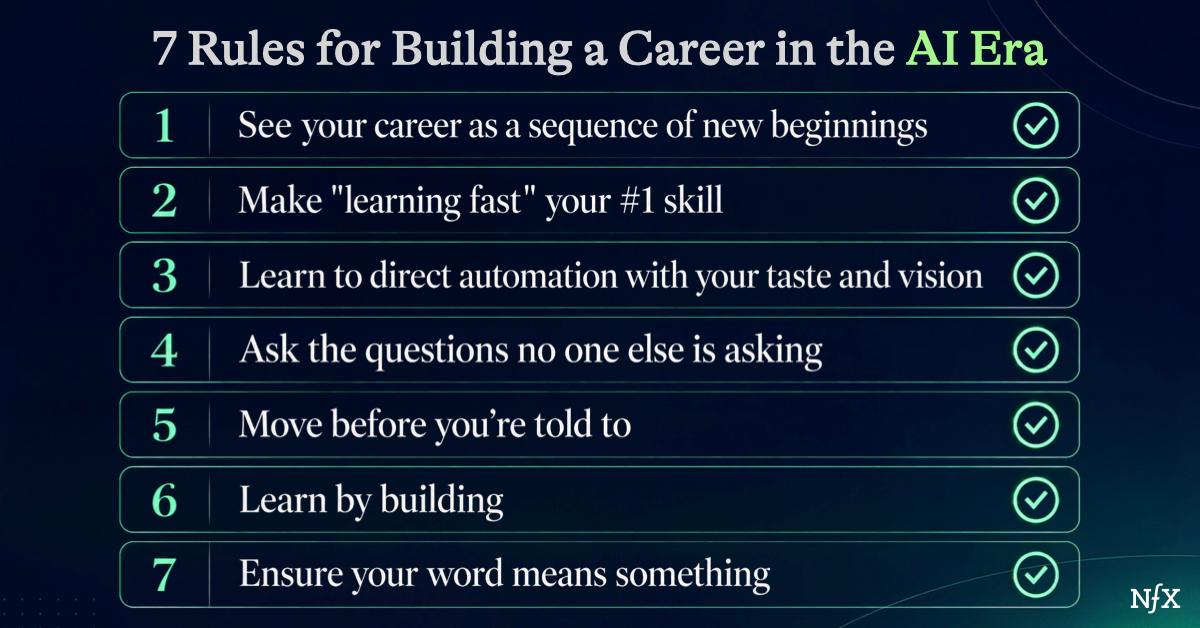
Begin with this: Your career is now a sequence of new beginnings. You’ll develop expertise and experiences, but your job will be applying that learning to an ever-growing fleet of automated systems. Of intelligence that you direct.
That’s what an entrepreneurial mindset has always meant: ask the question no one else is asking yet, move before you’re told to, learn by building instead of waiting for certainty, and be someone whose word is worth following into the unknown. Founders have never had a safety net, so they never had a choice. That’s what makes them the perfect people to fully embrace this new world.
AI was never a technology crisis. It’s a crisis of leadership. And you have just received a battlefield promotion.
Nobody trained you for it. It has more responsibility than any job you’ve ever had. But more potential, too.
Take the title.


As Founders ourselves, we respect your time. That’s why we built BriefLink, a new software tool that minimizes the upfront time of getting the VC meeting. Simply tell us about your company in 9 easy questions, and you’ll hear from us if it’s a fit.