

For decades, every new wave of software came with the same promise: it would make your employees faster, smarter, more productive. But the model was always the same: humans in the center, software as a tool.
No more. We are in the middle of a dramatic shift. The old model was software enhancing people. The new model is people orchestrating agents. We wrote about this first in 2023 when we called it “The 3-Person Unicorn.” That was back before the term “AI agent” was widely known – now it’s everywhere.
Today, software IS the people. If software ate the world in the 2000s, it’s agents that will inherit the earth in the next few decades. Every company is going to be animated with agents to varying degrees.
You need to start building your company this way right now, and adjusting your psychology to embrace this new reality. It’s still early enough where, if you’re reading this, you can become an early adopter and move 10x faster than your competition. But if you wait any longer, you’re going to be playing catch up to a competitor with a fraction of your headcount and 10x your velocity.
This is how your company and psychology needs to change:
The Leap From Tools to Employees
First, realize that software is no longer a tool. You need to think of your software itself as an employee.
This is a big shift. For decades, we have viewed software as a tool, and the human as the labor. But today, software and labor have fused into one entity. This is part of the reason the AI agent market is going to be so large – it’s not the size of the software market, it’s the size of the software and labor market combined.
Every time you think about buying software or creating an internal process in your company, you should be thinking in outcomes, not processes. You are no longer buying a CRM to help you organize contacts, you are buying a “sales operations agent” responsible for inputting, cleaning and updating your data, thus 10xing your pipeline.
Once you start thinking of software as an employee rather than a tool, you need to make the second mental shift: thinking at 100x scale.
In the new agent world, you don’t just open one window to open one task. You open fifty at once. Each agent you ‘hire’ should be working on a task in parallel, like musicians in an orchestra. And in more advanced cases, an agent will manage multiple agents for you, delivering only the aggregated outcomes of the work of all of them combined.
Once you make these two mental shifts, the result is that a 12-person startup starts to feel like a 1,200-person company.
We’re seeing this happen already. It looks like this:
- Customer support runs on agents who resolve 90% of issues, surfacing only the hardest problems to a small human team.
- Dozens of specialized agents write, test, and refactor code in parallel.
- Growth experiments run continuously, with agents generating copy, targeting segments, trying new influencers, testing new viral mechanisms, and targeting competitors’ social media, generating new funny videos about the product. Agents ‘work’ on all platforms to convince potential customers to try your product – never being rude, never losing energy, never taking a break.
- Data cleaning, reporting, and monitoring are done automatically, and integrated into every process seamlessly.
- Agents run competitive analysis, scrape changelogs, track feature announcements, interview your users, cluster complaints, rank opportunities, and produce battlecards overnight.
- Instead of one designer juggling Figma tabs, you have agents creating variations of flows, icons, layouts, and prototypes in parallel. A single designer becomes a creative director managing a flock of tireless junior designers.
- Your FP&A “team” is a hive of agents pulling real-time revenue, spend, CAC, churn, anomalies, seasonality, scenario simulations into a live, always-updated dashboard as other agents monitor it, notice anomalies and offer fixes
- You have 40 agents running sourcing sweeps across GitHub, LinkedIn, and obscure Discord servers. They draft outreach, schedule calls, run compensation benchmarks, prep interview rubrics, and flag only the top 1% of candidates for a human to review.
This is a new kind of company: a thousand simultaneous experiments, constantly learning, and importantly implementing those learnings.
This is particularly exciting because we know that the 1,000 simultaneous experiments mindset creates amazing companies and products. And this huge shift is often overlooked – the benefit of using AI agents is not just the labor cost they replace but also the fact they allow you to scale experimentations indefinitely.
We see it in the gaming world all the time. In gaming, when you put the game out, that’s just the beginning of a constant iteration process. If the data tells you the players don’t like a feature, or are bored with the content, you change it. It’s not personal, it’s just the data.
Our best gaming founders understand this intuitively, and we coach all of our founders to have this mentality. But AI has made this possible on a new scale, across every possible type of startups.
You are not building a product, or even a company. You are orchestrating 1,000s of simultaneous experiments.
It Takes a Unique Mentality to Succeed In This Era
People like to say that AI is making it possible for everyone to be a founder. That is somewhat true – it’s never been technically easier to build a product than it is today. But psychologically, not everyone has what it takes to succeed in this agentic era of 1,000 experiments.
The few people you do hire at your company matter more than ever. They must be entrepreneurs within your organization. They need to be thinking like someone who has the resources of a 1,000 person team at their disposal.
These are the traits that lead to success in that arena:
High agency: They don’t wait for instructions. They take responsibility and act.
Multi-domain fluency: They’re able to think marketing, operations, and engineering all at once. They refuse to stay in one lane.
Builder’s instinct: They make things with their own hands. If something breaks, they fix it. If something’s missing, they prototype it. They have a bias toward creation. It doesn’t mean they all need to write code – a lot of the agent creation and implementation will be done through prompting – but they need to know how to create and manage agents.
Comfort with chaos: Agents fail, models drift, things break. They stay calm, and adapt.
Truth-seeking over status-seeking: They share information, including failures. Everything is public and out in the open.
Low ego: experimentation is failure. They are able to separate themselves psychologically from the product.
..but not low self-worth: if you believe you are destined to fail you will handicap yourself before you even start. They have confidence to move forward in the first place, without fear of failure.
Internal locus of control: They operate as if everything is their responsibility, even things they don’t formally own. If something is broken, if someone is stuck – they step in.
Systems intuition: They sense when a workflow, team, or agent network feels “off.” They can diagnose bottlenecks instinctively.
Willingness to unlearn: Old intuitions about “what takes time” or “what requires a team” are now liabilities. They can abandon outdated mental models instantly and adopt new ones when the world shifts.
This is Not About Efficiency
So much of the conversation around AI agents is focused on efficiency. People hyperfixate on how AI can reduce spending, or save time. What a lame way to think about one of the biggest advances in technology humanity has ever seen.
Instead, AI agents should prompt us to think bigger. To do radically different work, on a much larger scale. Things that were previously impossible because they were too slow, too costly, or too complex to coordinate. Today your company can move at a radically different pace, can address much larger markets and, yes, have lower capital requirements.
You’ve likely heard all of this before. The more interesting line of thinking is actually the reason why this is happening. It’s because, all of the sudden, AI has made risk-taking rational at a scale we’ve never seen before.
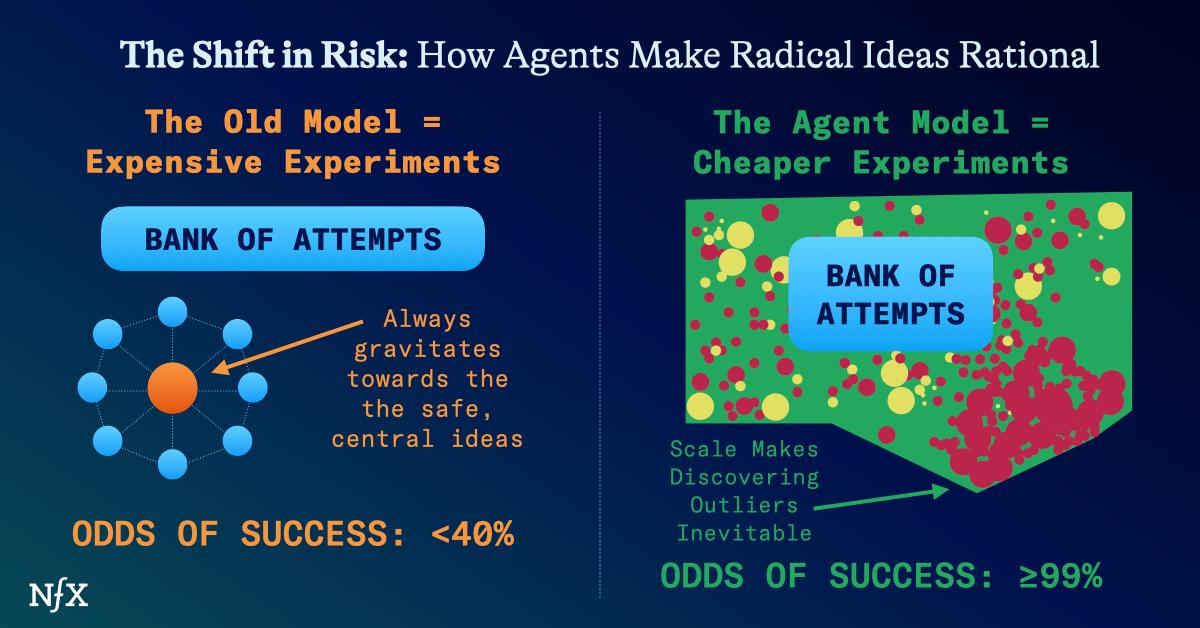
We often think of a seed round as a “bank of attempts” at finding product market fit – or put differently, a “bank of experiments.” With agents at your disposal, experiments just became far cheaper. If a typical startup might run 5-10 experiments over the course of their seed stage, today, you could run 50-100.
This change widens the scope of ideas worth testing. The crazier, the better. You have hundreds of tries, why not go for it? In fact, it’s actually responsible to go for it.
If any single experiment has, say, a 5% chance of revealing something meaningful – a new insight, a surprising pattern in user behavior, a workflow that resonates – then running ten experiments gets you close to a 40% chance of finding something worthwhile. Up that to 100 experiments and your odds are near 99%.
This change in rationality also affects what experiments you choose to run. When each experiment was costly, teams naturally gravitated toward ideas that felt safe or reasonable. Now that experiments are cheap, the expected value shifts toward the edges, where the unconventional or contrarian ideas live. Suddenly it becomes rational—not reckless—to test the strange, ambitious, or non-obvious.
In fact, the real risk in this new environment is failing to explore widely enough, because the upside now gathers in places that were previously too expensive or time-consuming to reach.
This new era is really all about expansion. About exploring, considering markets and product directions that once would have felt unrealistic. It’s a larger canvas for ambition.
The Mental State of the Future
It all comes back to the fundamental shift from tools to agents. When you have an infinite workforce, and can run infinite experiments, everything opens up.
You just have to readjust your psychology, and hire people who are on the same page.
The future belongs to the companies that make this shift now. Led by rare humans with extraordinary agency, orchestrating armies of agents to build what once felt impossible.
If you’re building today, your job is to rewire your own mental model — and then rewire your company’s.
The question isn’t if. The question is whether you’ll be leading that future, or chasing it.