

You’ve already had the moment. You may not have realized it.
Maybe you sat down at your desk and realized the first app you opened was Claude. Or you were on a deadline, and your first instinct wasn’t to search, or call someone, or think it through yourself — it was to ask AI. You used it the way you use Google Maps instead of asking for directions, without deliberation.
That’s the moment. Something has changed. We are calling it “functional AGI.”
There’s a version of the AGI debate that will go on forever — philosophers and researchers arguing about consciousness, general reasoning, and what “general” even means. That debate is real and worth having. But there’s another way to understand what AGI means in practice, and it has nothing to do with benchmarks.
The functional definition is behavioral: AGI arrives when people stop auditing the intelligence and start relying on it. That day has quietly arrived for many. For most people, on most tasks, most days, AI has quietly become the default. The other way still exists. It just increasingly feels like the old way.

This moment is arguably more powerful than the launch of ChatGPT in 2022. It’s likely even more powerful than the day true AGI formally “arrives.” This is the moment when things change — when products built in the new paradigm become truly sticky, and the economy begins to reorganize around a new default.
It’s happened many times before. And the pattern is always the same – and timing it is how great companies are built.
The Critical Mass Theory of Startups
In 2019, I wrote an essay on the critical mass theory of startups. It’s essentially a breakdown of why timing is everything for startups. You can go deeper into the theory here, but in essence, it comes down to three variables converging:
- Enabling Technology: technologies that make something newly possible. GPS, LLMs, MCPs, for example.
- Economic Impetus: technologies that make something newly affordable. Cost per token, AI agent workflows, for example.
- Cultural acceptance: when society at large becomes accustomed to a new idea. For example, when it became socially acceptable to post your life on social media, pay online, or when the federal government overturned a national ban on sports betting.
To truly take off, a startup needs all three. You want to enter a market when you are closest to that critical mass stage.
The hardest variable to predict is cultural acceptance. That’s because the data confirming a shifting cultural norm often lags years behind the true change. But that’s also perhaps why this is the most powerful ingredient of the three – it’s the hardest to predict.
If you have enabling technology, economic impetus, and accurately predict the cultural change, you have a very strong edge.
It’s easiest to see the power of this change through example. One of the most powerful examples is the algorithmic search engine wars of the late 1990s and early 2000s. It’s easy to attribute Google’s supremacy to elegant design, the PageRank Algorithm, and superior execution. They would have flopped without those things. But underlying that was the broader cultural willingness to turn to the internet for information.
Two datasets show this in retrospect. First, although the internet and always-on technology had existed for years, a growing number of people were going online between 1996 and 1998. In 1996, 23% of American adults used the internet. In 1997, 36% were online. By 1998, 41% of American adults were using the internet. Second, products like Alta Vista were teaching those people to search for information there. Altavista was a top-3 site on the Internet.
Google entered the market in 1998. By that time, people were already going online regularly. Many had already become familiar with the concept of search through products like Infoseek, Altavista, and others. Google didn’t need to teach users a new behavior – they simply needed to capture that latent demand for easily findable information with a magical, simple product. And they did just that.
This is a subtle variation on second-mover advantage. It’s less about learning from the mistakes of your predecessors than it is about capturing the behavior change that your competitors fought so hard to create. Altavista got people searching online; Google just made it more fun.
Since the rise of AI, we are seeing many more examples of this behavioral change. For instance, we may be seeing a similar moment of behavioral change around self-driving taxis in San Francisco right now.
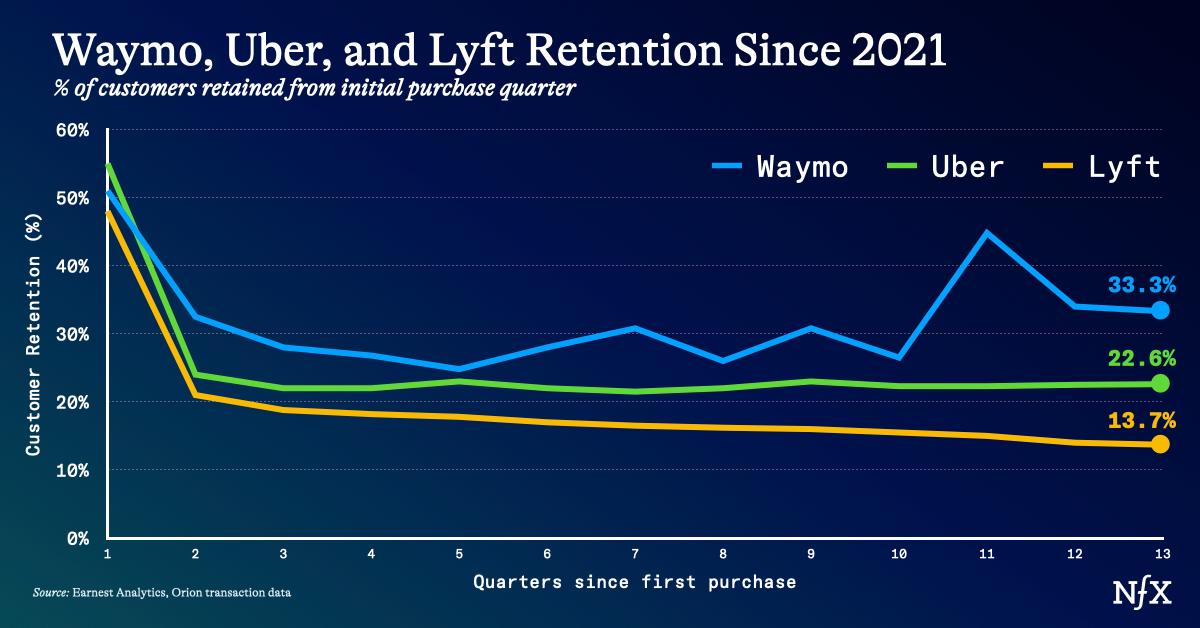
Several months ago, data surfaced suggesting Waymo appeared to have overtaken Lyft in San Francisco in terms of rides delivered. (Pretty much) Nobody is standing on a San Francisco street corner thinking, “I believe in the future of autonomous vehicles.” They’re just tapping the car that shows up first and getting in.
Waymo still has a long way to go, but it is starting to make significant inroads against two major incumbents – just like Google did against AltaVista. And they have the momentum because they’re building on the back of this cultural acceptance. Once people prefer self-driving cars, odds are they’re never going back. (We see this in their retention data as well – Waymo is retaining about 33% of customers from the initial purchase quarter compared to 22% at Uber, and ~14% at Lyft).
This is the moment we are in with AI. The large language model labs have created a strong and growing user preference toward:
- Instant responses
- Empathetic personalized communication
- Work that’s done automatically
- Data and insights delivered in natural language
They delivered on these promises. Very soon, it’s going to feel stupid to use an old CRM or a piece of industry software at work when you can have Claude make you a perfect deck in an hour on your personal computer. That’s what we mean by “functional AGI” – the AI is good enough to become the first line option.

The AI labs trained us to expect the above; now it’s up to startups to deliver that to every market imaginable.
In the Short Run, It Will Feel Like an “End”
These behavior shifts are the precursor to radical change. They open windows for excellent products. They create new markets. On a larger scale, they often trigger an economic reorganization.
These reorganizational moments are often filled with tension and strife at first. They feel like “the end.” Really, they are the beginning.
This is how people are feeling about software today. The throughline that it has become “uninvestable” or that “SaaS is dead” has permeated headlines for months. But as we’ve written previously, this is simply a reimagining. More doors will open than will close.
That said, it’s going to look like the end of certain industries in the short run.
For example, there were 124,000 travel agents in the US in 2000. By 2012, that had fallen 47% to 65,000, and retail locations were cut nearly in half. Tools like booking.com had existed since the mid-1990s. But consumer preference for online booking hadn’t materialized then. It did shortly after. By 2012, it was set in stone.
The idea of a travel agent didn’t go away. It was reimagined into a self-service online platform. Arguably, that change laid the groundwork for many new concepts, like Airbnb (which could never have been imagined when people were outsourcing their bookings to travel agents). Today, we may even see a shift back toward a more personalized travel experience, this time powered by AI agents. Constant evolution.
AI has made this evolution a given for nearly every perceivable industry (not to mention those that are unperceivable right now).
The Future Arrives Quietly
This morning, someone who works in a multi-billion-dollar industry – perhaps legal, or manufacturing, or space – opened ChatGPT to solve a problem that required specialist expertise or attention.
Their experience was probably good, but it could be magical.
Someone is building that solution right now. They will capitalize on the fast-moving water of “functional AGI.”
That person could be you.



As Founders ourselves, we respect your time. That’s why we built BriefLink, a new software tool that minimizes the upfront time of getting the VC meeting. Simply tell us about your company in 9 easy questions, and you’ll hear from us if it’s a fit.