

Picks and shovels in 1847. AWS in 2006. NVIDIA in the 90s. Investing in the collection of technologies that make innovation itself possible, at a reasonable price, is the least controversial strategy in the history of investing.
Infrastructure investments are often amazing opportunities, but timing matters. These windows tend to be shorter-lived, harder to spot than other “technology windows,” and are usually only obvious within specific networks of expertise.
Everyone has been focused on AI infrastructure for the last few years. But there’s been a massive opportunity just sitting there.
Space technology is one of the few infrastructure windows currently open to startups at scale today. (There’s a reason Elon is moving fast to own as much of this infrastructure as possible).
Growth of the space economy is projected to be comparable to the growth of the semiconductor industry. But we (and others) see the opportunity as far larger than this. Space technology expands not just where we build but what we are capable of building in the first place. We’re truly just at the very beginning of what is possible.
For investors or founders interested in foundational technologies during their formative years, the window is open now.
AI Infra Has Overshadowed Everything – But the Window is Closed
Why are you only hearing about this now? Because space infrastructure has been almost completely overshadowed by AI.
That’s not totally surprising. AI is the most dominant technology platform shift we’ve seen in decades, and everyone knows it. In 2025, 48% of all venture dollars went toward AI investments. The vast majority flowing toward foundational model labs and hyperscalers.
Unless you are willing to shell out billions, the infrastructure layer of the AI world is largely closed. (And even if you do buy in at those price points, the “hole” those AI companies must find their way out of is now on the order of $500B, per this great piece by David Cahn).
The AI infrastructure window is closed. And there are three telling signs:
- The ratio of known value to unknown value is now weighted towards the known. Everyone knows AI is valuable, so that certainty is now priced in. There’s a reason NVIDIA is now the most valuable company in the world, as of writing.
- The infrastructure layer now requires billions of dollars of upfront capital to even compete. This means only a handful of companies – all major tech incumbents – can even play the game.
- Network effects are fully in place. New infrastructure investments tend to be inherently unstable early on. A better price, or better product performance can drive users from one model to another (Think early Google: faster, simpler, better search performance compared to contemporaneous search competitors). But eventually, people become so embedded in a certain workflow that it’s nearly impossible to leave. Memory, context, plug-ins…people now have history with foundational model labs. Getting them to leave is a sisyphean task with those moats in place.
This is why we tend to focus on the app layer in the AI world, and specific verticals where there is still a lot of value to be created. When there’s no major incumbent (or a lagging, or outdated one), startups have the edge. When you’re designing new consumer experiences the ratio of unknown is still high enough to signal massive upside.
Wow, that was a long explanation of the nuances of AI investing at the application layer. So let’s return to space where it’s all, blissfully, a lot simpler. TLDR; You can still invest across almost the entire “stack” of the space economy today. The window is open, and it will not be for much longer.
And the crazy thing is that, because of the AI hyper-fixation, very few people are paying attention to this opportunity.
The Space “Tech Stack”
So what does the space technology stack look like?
Most people assume “space infrastructure” is all about satellites and rockets. Both of those sectors attracted the vast majority of funding dollars last year – mostly aggregated in larger, later-stage rounds. (Likely driven by a surge of interest in defense-related technologies).
But the infra landscape is actually far broader than just launch and sats. Space economy insiders understand this. There’s a reason that Elon recently referred to SpaceX’s decision to acquire xAI as a move to “form the most ambitious, vertically-integrated innovation engine on (and off) Earth, with A.I., rockets, space-based internet, direct-to-mobile device communications and the world’s foremost real-time information…” (He also mentioned data centers in space as a primary impetus for the acquisition.)
TLDR; Musk is aiming to own the entire stack of the space economy. More likely, he wants people to think he is the only one capable of owning the whole stack. In reality, this is unlikely to be a market with one single winner. The scope of what is possible in space is simply too large (and there are too many highly competent competitors building at each of these layers today, like Stoke for launch and Starcloud).
A few major players will lay the infrastructural foundation, and many more startups will emerge as we move up the stack, empowered by increasingly cheap, reliable, and available launch, satellite infra, compute and more. We are most likely moving toward a dynamic with multiple large-scale winners at each layer. Only a handful of elite companies (like SpaceX) will become fully verticalized (from launch to apps). And now is the time to seek those opportunities out. But after that, the alpha will move up the stack towards apps – just as it has with AI.
This year is probably the last moment for early-stage investors to get significant shares of this whole stack.
So how do we break down the emerging “space stack?” We see 3 distinct layers of pure infrastructure today, plus the emerging application layer.
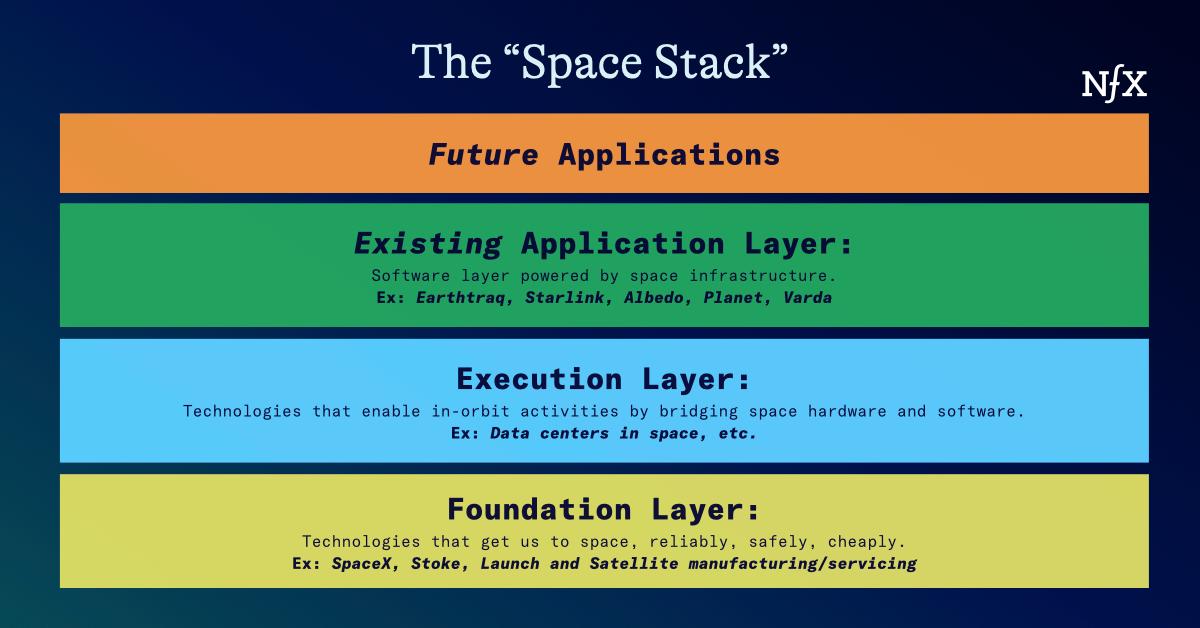
Launch: It’s rent. For anything to happen in the space economy, launch has to be reusable, cost-effective, and reliable.
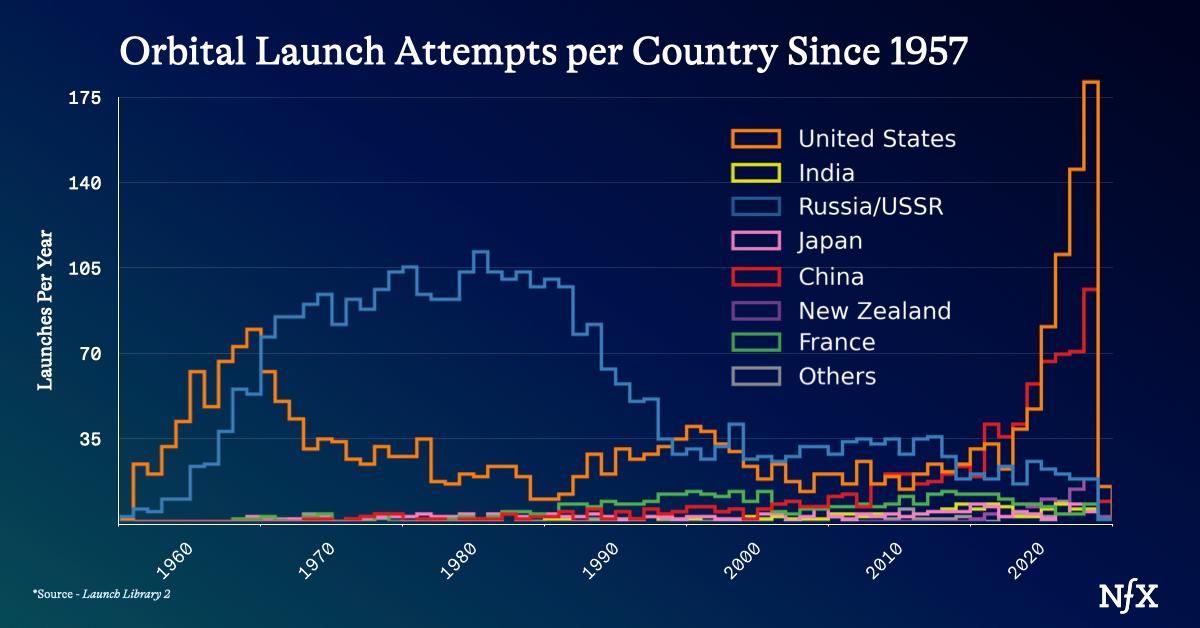
This is the layer that feels the least “sci-fi” today, because it’s actually happening. In 2025, there were 330 launches – more than ever before. And 180 of them were done in the US – a record for the most launches conducted by a country in a single year.
Launch is on the path to becoming cheap and normal. It’s simply a question of who will win, and how fast. Most likely, there are going to be a handful of winners. To be honest, those winners are becoming quite clear already.
SpaceX is a leader, obviously – they still control about 50% of global launches today. But our company Stoke is a very strong contender here with a nuanced value proposition. Whereas SpaceX will take you generally where you want to go in space, Stoke will take you exactly where you want to go.
Satellite Manufacturing: In 2025, the United States launched a record 4,526 satellites. The U.S. alone was responsible for the vast majority of them.
There are plenty of opportunities for startups in this area. The old aerospace primes are being challenged by a number of competitors. For example, Apex is building satellite buses at scale like an automotive assembly line. Our company Starfish Space is still at an early stage, but is pioneering on-orbit servicing.
The more satellites we launch, the greater the opportunity to service them directly becomes. This layer of infrastructure is being actively developed today.
Data & Compute: Now we start to move into the “execution layer” of infrastructure. These technologies are the connective tissue between hardware and software. This layer allows us to activate space infrastructure and use it to solve any number of problems.
Data and compute is the most obvious way hardware and software intertwine, and solve a problem, in space today. Though it wasn’t obvious even a year ago. Back when we invested in Starcloud, the idea of data centers in space was borderline insane to the uninitiated. In a matter of months, that conversation changed dramatically.
Now, Starcloud is a frontrunner in a very real race to create the systems needed to unlock on-orbit compute. This window was wide open, and they saw the potential before anyone else.
Positioning and Navigation: Positioning, navigation and timing (PNT) have been among the largest sectors of the existing space economy for decades. Early government investments in satellites opened up this market, and created the backbone for many of today’s biggest apps (Google Maps, the foundational maps for Uber, Lyft, etc).
But once new layers fall into place, there is room for significant improvement upon these decades-old systems. Hyper-accurate mapping is a clear example. (Think autonomous vehicles or augmented reality – both need hyper accurate location data to function.) This layer is only now emerging.
Interestingly, we’re already beginning to see nascent “applications” developed on this new PNT infrastructure. Our company Earthtraq for example is developing precision navigation and positioning that doesn’t require existing GPS. Their system works anywhere on earth (including indoors), and is projected to be 100x cheaper than standard GPS receivers.
To be fair, EarthTraq is a bit of a hybrid infra/application case here – they’ve built both new infrastructure AND are developing new tools on top of it. In the future, the app layer may be pure software – but that’s still very nascent.
Taken together, numbers tell the story of an infrastructure layer that is open to investment now, but it’s moving along the path to lock-in. The most obvious areas of “space infrastructure” investment today are launch and satellites – and those windows remain cracked open. But there’s so much more to come once you see the full stack.
Why Infrastructure Windows Are Exclusive
As we just said, infrastructure windows are rarely open for long. But when they are open, it’s usually only obvious to a handful of very connected, and knowledgeable people in the industry.
In the spirit of transparency, that network is how we became space investors in the first place. We didn’t study rocket science, or spend hours pouring over the unique architecture of heat shields in college. But we were one of the first VCs to get a chance to speak with Andy Lapsa, the founder of Stoke Space.
At the time, they told us they didn’t need more space investors, they needed a backer that would support and believe in them 100%. We believed in them because 1) we know what a great team looks like, 2) we saw the right ratio of imaginable possibilities to unimaginable possibilities, and 3) we know how to due diligence a technology and what we saw from Stoke was genuinely impressive in the field.
That Stoke deal opened us up to an entire world of space infrastructure. Once you solve for launch, you know what technologies are obviously the next step. Satellite manufacturing becomes cheaper. On-orbit servicing becomes possible. Space-based data centers move from science fiction to a legitimate business case. High-precision GPS enables applications we haven’t even conceived yet.
None of that is obvious or available, until you break into the network.
Consider this your initiation.
Time is Limited
Infrastructure windows don’t stay open just because the market is growing. They close when the winners become obvious, or when the capital requirements become prohibitive for new entrants.
In AI, that consolidation happened fast. In space, we’re watching it happen now, layer by layer.
Launch is consolidating already (Stoke/SpaceX). Satellites will soon follow (Starfish, Starlink, numerous others). At these layers, it’s becoming increasingly obvious just how valuable space is. If SpaceX follows through with their potentially record-breaking IPO this year, it will likely hammer this point home for anyone on the fence.
But the edges of the foundational layer and up are still being defined, for now. Once they’re defined, the layers of the stack become immovable – and essential to hundreds of downstream use cases.
This is the moment when the infrastructure layer is being built, the winners aren’t decided, and the technology windows are genuinely open.
Consider this your final opportunity to go where few VCs have gone before.


As Founders ourselves, we respect your time. That’s why we built BriefLink, a new software tool that minimizes the upfront time of getting the VC meeting. Simply tell us about your company in 9 easy questions, and you’ll hear from us if it’s a fit.