

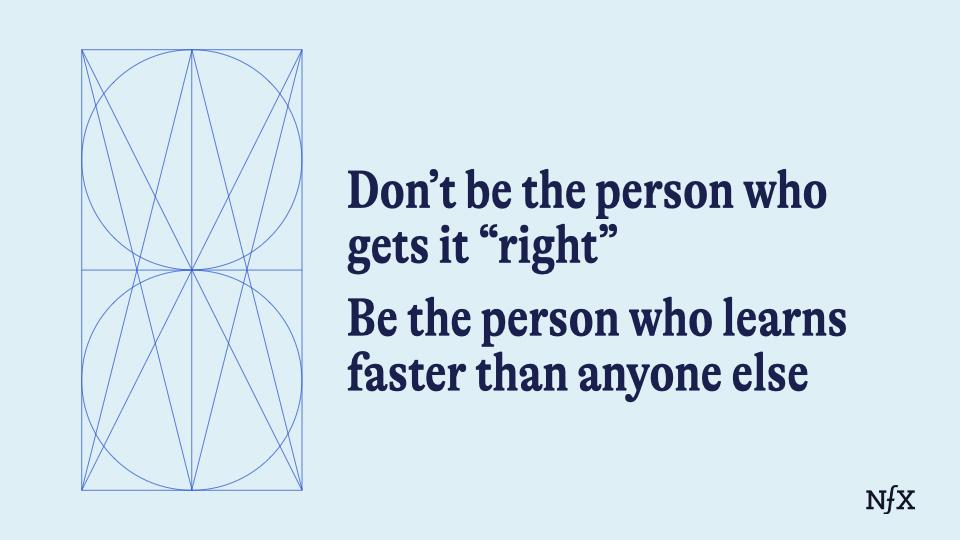
When we look at the traits that predict success for early-stage founders, they all boil down to one thing: speed. But most founders aren’t fast because they don’t have the right psychology.
Here are 6 ways that we help our founders learn to move fast. It starts by realizing why your mindset is slowing you down.
The ideas in this essay are adapted from a talk I’ve given for years within the NFX Guild. It’s one of the most transformative sessions we do. That’s why we’re launching an entire season of Masterclass on this topic.
Get it here when it drops: nfx.com/subscribe
Why AI is Faster Than You
No one will be able to move faster than generative AI itself. But not for the reasons most people think.
- AI won’t be perfect. But it will be faster and more accurate than us on most days, doing most things.
- AI won’t fear derision from its college classmates. It will launch the product.
- AI won’t lay awake at night worrying and therefore fail to perform due to lack of sleep.
- AI won’t procrastinate.
- AI won’t have its ego bruised and cling to a bad idea.
- AI won’t self-sabotage because it doesn’t feel worthy.
For humans to match the speed of AI, they need to be clear-minded and fearless.
So don’t wait. Do it now. Don’t stand in your own way.
The 4 Benefits of Speed
There are four major benefits of the speed strategy.
- Quality: your product gets better, faster.
- Productivity: you and your team have more fun when you get more done.
- Network activation: speed and momentum is seductive. You’ll generate more attention from potential customers, employees, press, and investors.
- You will keep more equity in your company: your valuation will go up, and your costs will go down, reducing the need to raise more capital.
Sounds great, right? So why don’t more people go faster?
The Main Speed Barrier is Your Mind
The biggest issue I see is that most people’s “speed bars” are just set too low. You think you’re going fast, but you’re not.
But it’s not your fault. Your speed bar was set too low by the fact that you’ve already been successful. Most founders we see were good at school. School is slow, based on calendars and long deadlines. Or maybe you were a great employee at a major corporation. How fast does a high status corporation move?
You have been trained badly by your environment. To overanalyze, to double check, to ensure everyone has an opinion on every decision. Maybe you feel like you have a lot to lose. You don’t want to reset your speed bar because of fear you will stray from the processes that gave you success in the past.
The first step to moving fast is to reset that bar: Find a 10X faster benchmark and reach for it.
Here’s an example. About a decade ago, we got into the online video gaming business without having built a game before. Logically, we said: ‘let’s hire video game developers who will know better than us.’ Those successful video game developers then told us it would take 12 months to build a really good game the team could be proud of.
I said: “I was thinking of 35 days, not 12 months.”
They told us it was impossible. But one of my web engineers, who had never been in the gaming space, told us he could build a game in 21 days by himself.
21 days later he delivered a working game built in Flash for the Web. That game got 3 million users in 3 weeks.
The gaming people’s minds were blown by the speed. No one builds a game in 21 days! But this web engineer didn’t know he “couldn’t.” He had no context. No industry standard speed bar holding him back.
Here’s the speed bar for most product launches before generative AI: if you’re not experimenting between 20 and 100 times per week, you’re moving too slow. If you’re not hitting 20 to 100 experiments per month, you’re out of the game.
Now, perhaps, the speed bar is even higher.
How Mindset Creates Speed
Most of you will have to unlearn decades of slowness.
Most product founders look for speed via working more hours. Or productivity hacks. Time management skills. Slack tricks. Better delegation principles. Zaps and automations. Faster tools. But the truth is that a) AI will figure all that out and do all those tricks for you and b) none of that matters if you don’t have the mindset you need.
Adopt these mindsets to get speed.
1. The product is not you
What you’re building is not a representation of you, how smart you are, how much you’ll be loved.
Just get it out the door.
You need to get your product into market to really see what works. Watch your competitors closely and borrow the best ideas. Don’t make it perfect. Make it exist.
2. You’re just running experiments
You are not here to “play business” or even to “build a product.” The fastest mindset is to think of what you’re doing as running a series of experiments. This will set you free.
This is even more pressing given the speed, capability and ubiquity of generative AI. The experimenters who create the third wave of AI companies – the visionary stuff, the stuff we can’t imagine yet – are going to discover what works.
The experimenters are going to win.
3. Embrace borrowing
To get away from your fear, borrow from others. You don’t need to invent everything. Copy things that work. Don’t debate it so much. Just get it up and get the data.
If you need a calendar feature, copy the best calendar. Facebook copied Friendster. Google copied everything.
It’s okay. Eventually, you will create something unique because you have a unique mind.
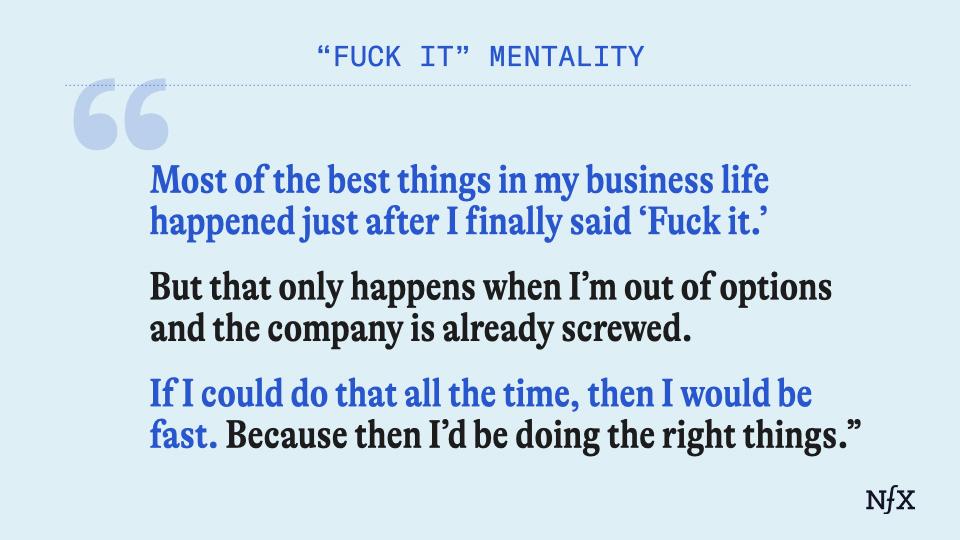
4. Adopt the fuck it mentality
The best things that happened in my business career happened after I finally said, “fuck it.”
We were running out of money. Our backs were against the wall. I gave up and I did the right thing: I got out of my own way. I built the product the market wanted.
You can start with this mindset. Don’t wait for the last 30 or 60 days of capital to adopt that mindset.
5. Drop the self-sabotage
Outstanding founders usually have an unusual source of drive. For some of them, it comes from feeling unworthy and thus needing to prove something. This can drive great success, but it also leads to self-sabotage.
If you have this, you need to be aware of it and get past it. Have your co-founders call you out on it.
This is a process. But there’s enough on the internet now to educate yourself about this state of mind. Spend some time thinking about the subtle ways that you might be hampering your own success.
6. Do it for someone else
If you’re not going to go fast for yourself, then go fast and win for someone else.
Go fast for your employees, your investors, your users, your family. They are depending on you, and you owe it to them. Don’t hurt them with your procrastination or unwillingness to decide and focus.
Mindset > Hours
There is a lot more to say about going fast in startups, but most of it comes down to this: it’s not about more hours; it’s about your mindset.
When AI can do everything a human can do, your mindset will give you the edge because it allows you to get out of your own way and learn faster.



As Founders ourselves, we respect your time. That’s why we built BriefLink, a new software tool that minimizes the upfront time of getting the VC meeting. Simply tell us about your company in 9 easy questions, and you’ll hear from us if it’s a fit.