

Founder comp is one of the most awkward conversations in venture, and many founders have no idea how to have it.
They don’t know where to start, whether to change their pay as things evolve, or how to talk about it if they do.
Get it wrong, and there are real consequences: you create tension with your team or your board, or you disincentivize yourself from the outcome you started the company to get.
There’s no one-size-fits-all manual here. Every company is different. But after walking enough founders through this, a few guidelines hold up every time.
The Core Philosophy
Incentivize yourself to succeed, without ruining your life or your family’s life. For many founders in the USA, that means keeping about $2K for savings every month.
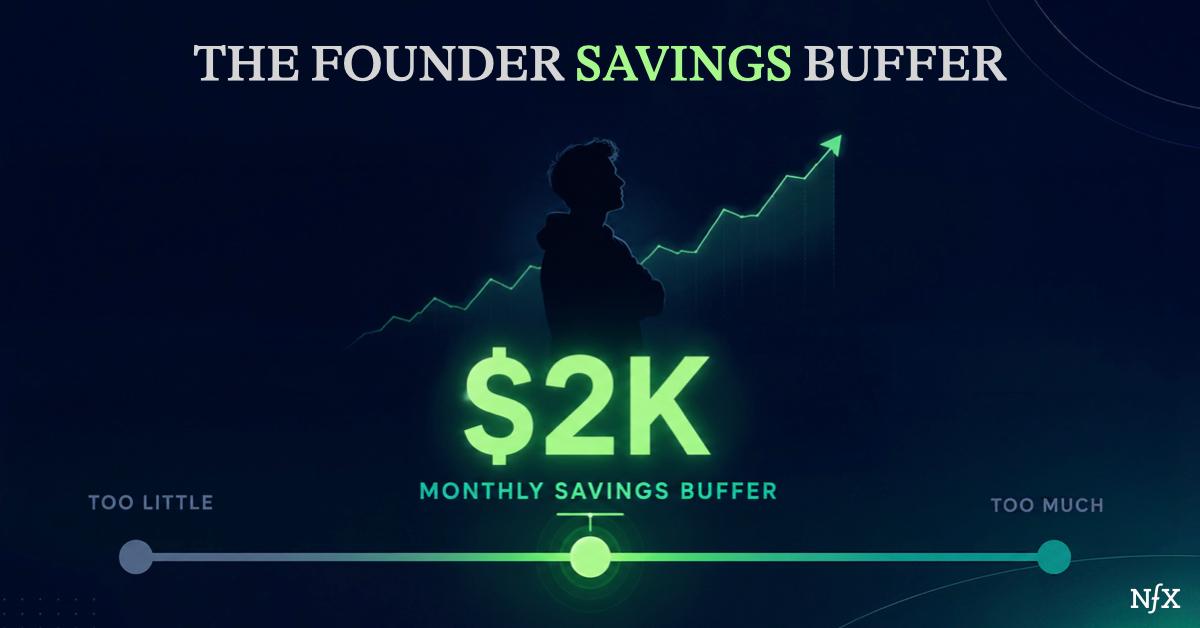
Notice what’s missing from that sentence: salary range. That’s deliberate. The right amount to pay yourself isn’t a market rate you can look up — it depends entirely on your life circumstances and how your company is actually doing, and both of those change. Any framework that leads with a dollar figure is giving you the least important part of the answer. How you arrive at the number matters.
Three principles get you there:
- Feel Like an Owner, Not an Employee
- Don’t Burn the Ships
- Don’t Overdo It
Let’s go through each.
Feel Like an Owner, Not an Employee
You did not start a company to get rich in the short term off your salary.
Especially today, that’s a harder line to hold than it used to be. OpenAI’s L5 software engineers are pulling in $1.15M in total comp as of May 2026. Many frontier labs pay even more.
If you’ve chosen the founder route, you’ve chosen a different path — one that can be far more financially rewarding and freeing in the long run, but only if you play it as a founder and not as a salaried executive. The beauty of being a founder is the ability to pursue your mission and vision with full creative control. You’ll never get that as a cog in the corporate machine.
Remember you chose this for a reason! You can’t constantly worry about what you would be making in salary if you worked for OpenAI/Anthropic or the major hyperscalers.
Instead, you want the long-run value of your company to matter more to you than any nominal salary bump ever will.
One of the biggest mistakes you can make is to treat yourself like a for-hire CEO — someone who negotiates a salary from the board and settles into golden handcuffs or a golden parachute. NFX wants to work with founders, not for-hire CEOs. That distinction matters enormously to us, because it affects how much a founder remains invested in their company over time.
Protect the feeling that you are an owner – that your company’s success and your success are the same thing.

We are particularly careful about this with our bio companies. Under the East Coast venture formation approach, we’ve seen plenty of scientists become employees in their own companies. Under our West Coast philosophy, we believe you should remain part of the founding team, a true owner the whole way through (even if you do bring tech people or business people on board to shore up your weaknesses).
So pay yourself enough to be comfortable (again, save around $2k/month), but keep the long-term upside as the real prize.
Don’t Burn the Ships
Here’s another common failure mode: founders who refuse to pay themselves enough. The theory is that if you burn the ships behind you and live on ramen for ten years, it buys you a better outcome.
This impulse starts from a good place. It is true that every dollar you pay yourself comes straight out of your runway. But people go wrong when they turn that good intention into a religion. Suffering by going into personal debt or causing tension with your family is not worth it. (Trust me, you will suffer plenty as a founder; don’t add personal financial issues on top of it.)
Founders who don’t pay themselves enough also tend to quit early. If you’re knee-deep in debt, even a mediocre acquisition starts to look appealing — even when staying the course would have made you far more.
(One reason many VCs like working with second-time founders: they’ve usually banked enough from a prior exit to be financially comfortable already, which makes them more willing to hold out for the life-changing outcome, or just to keep building because the mission and product still matter to them. For a lot of them, it stops being about the money at all.)
Don’t put yourself in that position. Take care of yourself and your family, and commit to building something that actually matters. Pay yourself enough to keep a real buffer for when life changes.
What “enough” means is specific to you; it is not specific to what your peers are doing.
Don’t Overdo It
The second failure mode is the exact opposite of burning the ships: founders who want to play business. You know the type — first class on every flight, an inflated salary to feel important. We call them the wantrepreneurs – a person who loves the idea, status, and lifestyle of being a business owner, but fails to do the real work.
We’re not saying you should suffer for the aesthetic of frugality. Don’t fly coach to Asia every month and walk into your most important meetings running on no sleep (that’s penny-wise and pound-foolish). But don’t fly first class to every meeting either. Find the balance – it’s just common sense. The same logic applies to your salary.
Another thing to consider: whatever you pay yourself acts as a soft cap on what you can justify paying senior hires. If you spend a large chunk of your raise on your own salary, you’ll end up paying more for your team too. The number you set for yourself isn’t just about you.
Also, do you prefer a $1M salary with 50% tax, or a life-changing exit with a qualified small business stock tax exemption and long-term capital gains tax? Again, the upside is where you want your focus.
When Comp Can Change
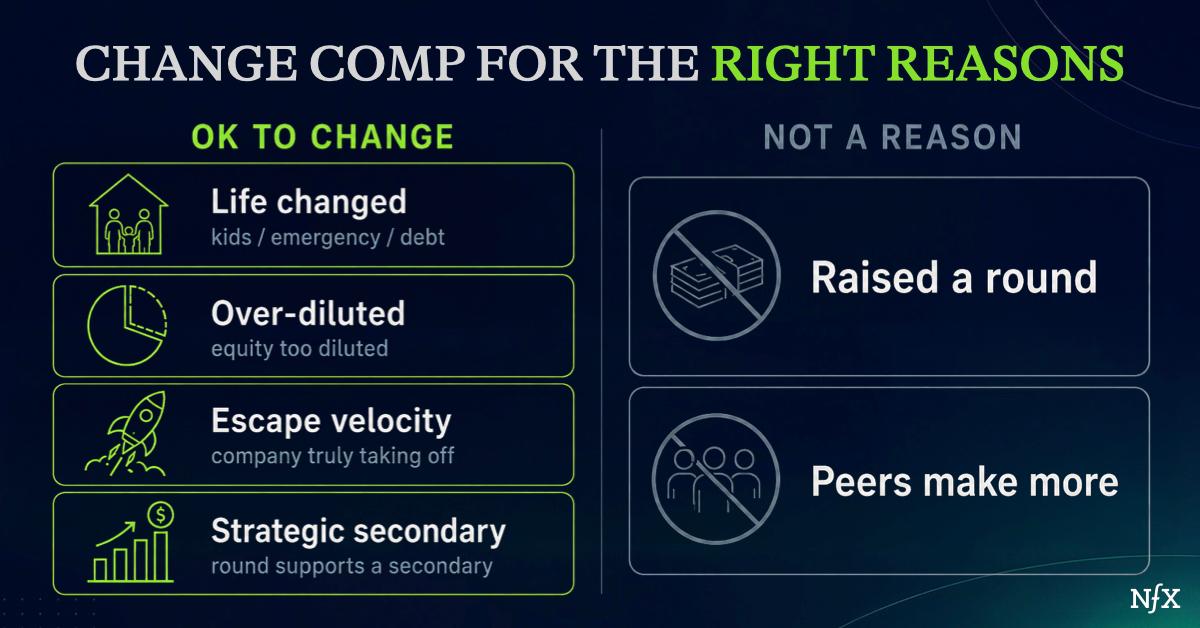
Your comp doesn’t have to stay frozen forever. But it should move for the right reasons, and be communicated clearly and honestly.
Change your comp / get some money off the table when:
- Your life has materially changed — kids, an emergency, a real risk of personal debt
- The founders get over-diluted to the point they have an “employee” level equity.
- Your company is taking off and genuinely at escape velocity.
- A strategic secondary makes sense –– valuation is high and justified, and the round is oversubscribed.
Don’t change your comp because:
- You just raised a round. A raise is a fundraising success, not a company success — don’t let it feel like a bonus
- A survey shows your peers are making more. You’re not a for-hire CEO benchmarking against the market.
On secondaries specifically: they’re a legitimate tool. They can take life-changing money off the table without forcing an exit, and they keep you incentivized to keep building.
This is why many smart investors (like NFX 😉 ) will support this – they want to incentivize you to create a huge venture return and not sell the company early, and often see secondaries as a means to this end. If your valuation is high enough and you have enough demand, you can sell enough to have a meaningful outcome post-tax while still owning enough to feel like a founder, maintaining your upside, and keeping control of the mission.
But some founders push for a secondary into every round, regardless of circumstance. That defeats the point.
Now, if one of those legitimate triggers actually applies to you, how you communicate the change matters as much as the change itself.
Here’s what not to do:
- Don’t slip it into a board slide and hope no one notices. We will notice, and it’s a terrible look.
- Don’t vote on your own comp. Bring it to the compensation committee.
- Don’t lead with “my peers make more.”
What you should do instead: bring your actual situation — good or bad — to the compensation committee, directly. Your investors are not trying to take money out of your pocket. They want you focused, not stressed about rent or one bad month from quitting.

There are plenty of ways to talk about a comp change that keep you feeling like an owner, not an employee asking for a raise.
Their interest is the same as yours: the company succeeding. That’s the whole point of the conversation — not negotiating against your board, but checking that your incentives and theirs are still pointing in the same direction. Your focus is part of that alignment.
The Real Test
None of this is about the size of your paycheck. It’s about whether you still feel like the owner of what you’re building, or whether you’ve become an employee of your own company.
Get that part right, and the number takes care of itself.



As Founders ourselves, we respect your time. That’s why we built BriefLink, a new software tool that minimizes the upfront time of getting the VC meeting. Simply tell us about your company in 9 easy questions, and you’ll hear from us if it’s a fit.