

The “three-person unicorn” experiment has been running for three years now, across hundreds of companies — our portfolio and beyond. Everyone gets the headline: small team, move fast. But there is still a massive gap between the companies that get the structure right and the ones that don’t.
The three-person unicorn was never just about low headcount and “using AI.” It’s about the systems that let those people work together, treating AI like a coworker instead of a tool, and building the whole company around one mission: a great product.
Get the structure wrong, and you end up with a pile of tools, a mediocre product, and no speed. Get it right, and you take off.
Here’s the structure we’re seeing win — and the traps that catch first-generation AI-first companies.
0 to 1 is Solved, 1 to 2 is Your Bottleneck
The old org chart — separate product, design, engineering, and support departments, with middle management in between — was built for a world where making the product exist was the hardest part. It was designed to get you from 0 to 1.
AI has solved that problem. It has never been easier to fill a blank screen in human history. The new bottleneck is going from 1 to 2: prototype, test, ship, learn — rinse, repeat. The emphasis shifts from building to verifying.
Today, the winning structure gets you to the launch and learn phases as fast as possible.
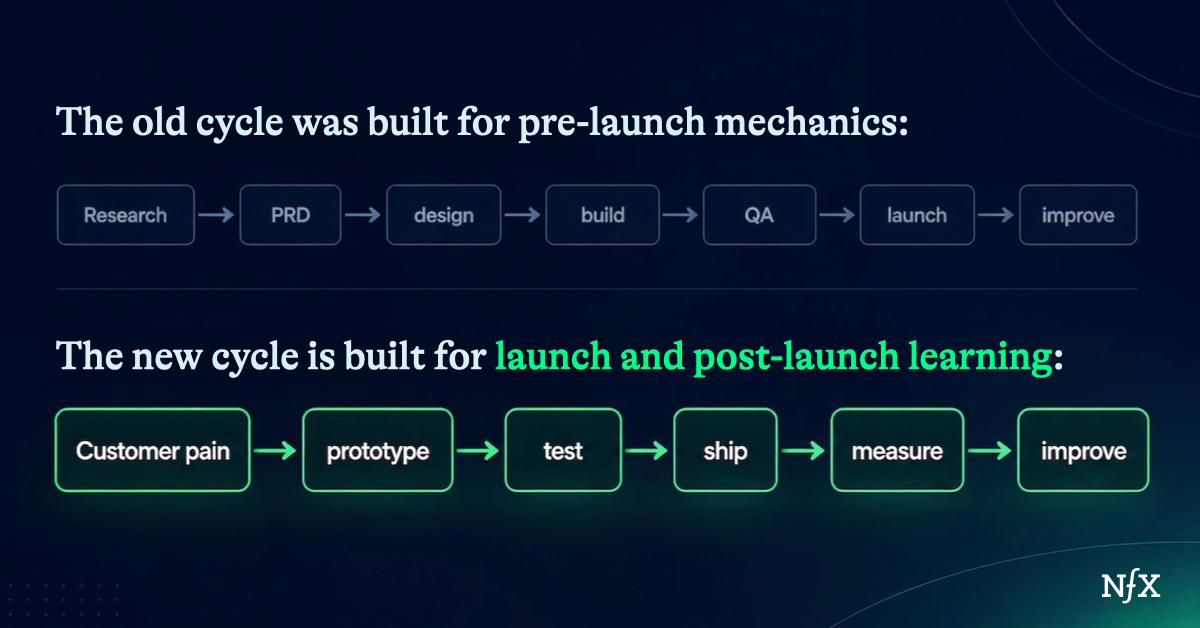
Ineffective AI-powered companies get stuck in pre-launch purgatory. AI makes it too easy to try everything, and the temptation is to ask AI whether the product is good instead of shipping it and letting real customer data decide.
Resist that impulse. Ship the product. Design your company to learn from the results fast.
Today, the winning structure gets you to the launch and learn phases as fast as possible.
The Mission Pod: An AI-First Company Structure
The structure we’ve seen work best for this is the mission pod.
Organize teams around outcomes, rather than job functions — solving a customer problem, perfecting a product surface, hitting a revenue target. Each pod owns that outcome entirely: understand the customer, prototype, ship, measure, iterate, without waiting on another department.
Inside a pod, the goal is to solve the problem with whatever tool it takes — product, sales, marketing, all of it. You’ll still have domain experts, as in the three-person unicorn model, but everyone works fluidly across functions, using AI to fill the gaps in their own skills and understanding.
Below are the five cardinal rules of building a mission pod:
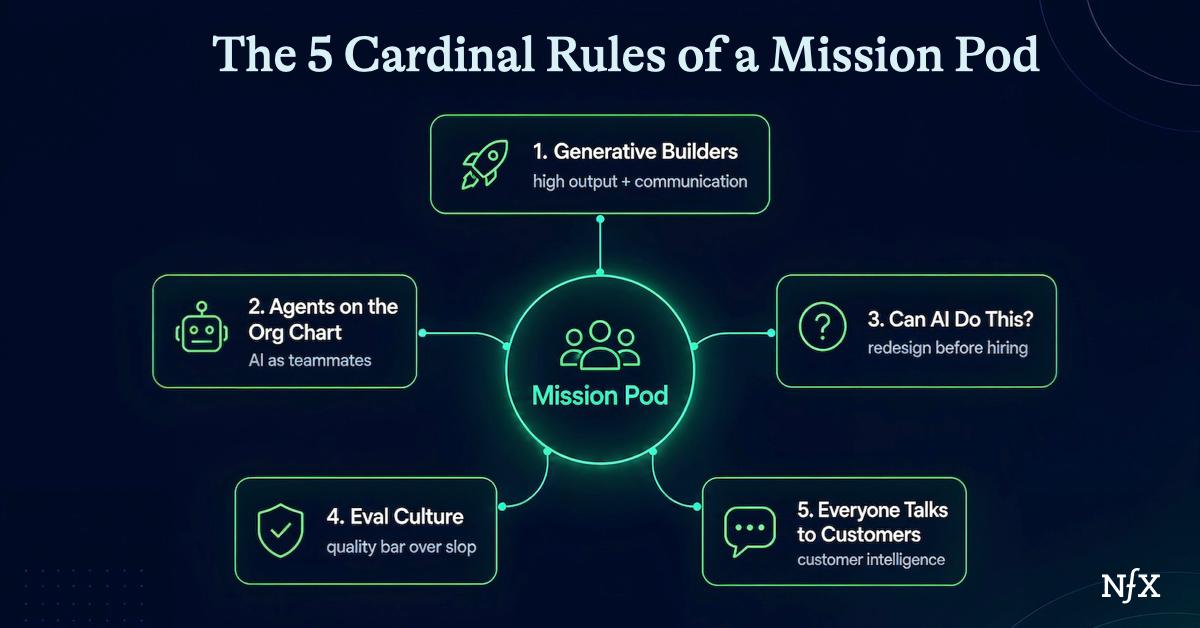
1) Hire generative people with strong communication skills.
Every person on the team should be capable of creating net-new output. They should have a track record of making something. There is no room for people who cannot ship something, especially in the age of AI, when output is easier to create than ever before.
But critically, that’s only part 1. The key is that your builders must understand how to refine results, take feedback, and communicate. Low ego, high EQ, team-players.
It’s a hard mindset to find. But it’s out there. These hires are relentlessly focused on shipping the next idea and approach and learning from the last. We call this the 1,000 Simultaneous Experiments Approach.
2) Agents belong on the org chart
Stop thinking of AI as software. Think of agents as teammates, and assign them work accordingly.
Every team should be able to say precisely which work is done by humans, which by AI, and which requires human review. If that map doesn’t exist, you don’t have an AI-native org — you have people with subscriptions.
3) Ask can AI do this? And evaluate results honestly.
Before you default to the hire, ask: Can AI do part of this? Can an existing person with AI do this? And even if it is not perfect, is the output good enough to ship?
The key here is not to assume that if AI can do something, the quality is high enough. Sometimes, you really do need to bring in a human expert. But recognize what AI can do well enough.
There will be some areas of your business where this paradigm works. Not everywhere – we are not saying you should always ship slop. But there is a middle ground that may work (and if it doesn’t, this gives you information about what’s most important to you).
This attitude may be met with some resistance. The key to avoiding that is to reward the effort of automating a process that drives a real outcome (not a vanity metric).
Get as far as you can, and then you get more resources. Not the other way around.
4) Build eval culture
The slop problem is real. Volume without judgment degrades your product, and your customers notice before you do. If AI produces ten times more content, code, or answers, and your quality bar doesn’t scale with it, you’ve automated your own decline.

Eval culture is your guidepost against producing slop. You must have clear guidelines for what is good enough to ship, and everyone must be on the same page.
5) Everyone talks to the customer
Customer intelligence is now the scarcest input in your company.
When anyone can build anything in a week, the advantage goes to whoever understands the customer best. Your engineers, designers, and operators should be talking to customers directly, or analyzing that data directly to inform your next move.
The Traps
Most companies understand all of this in theory, and then they fall into a few common traps. Here are a few we often see:
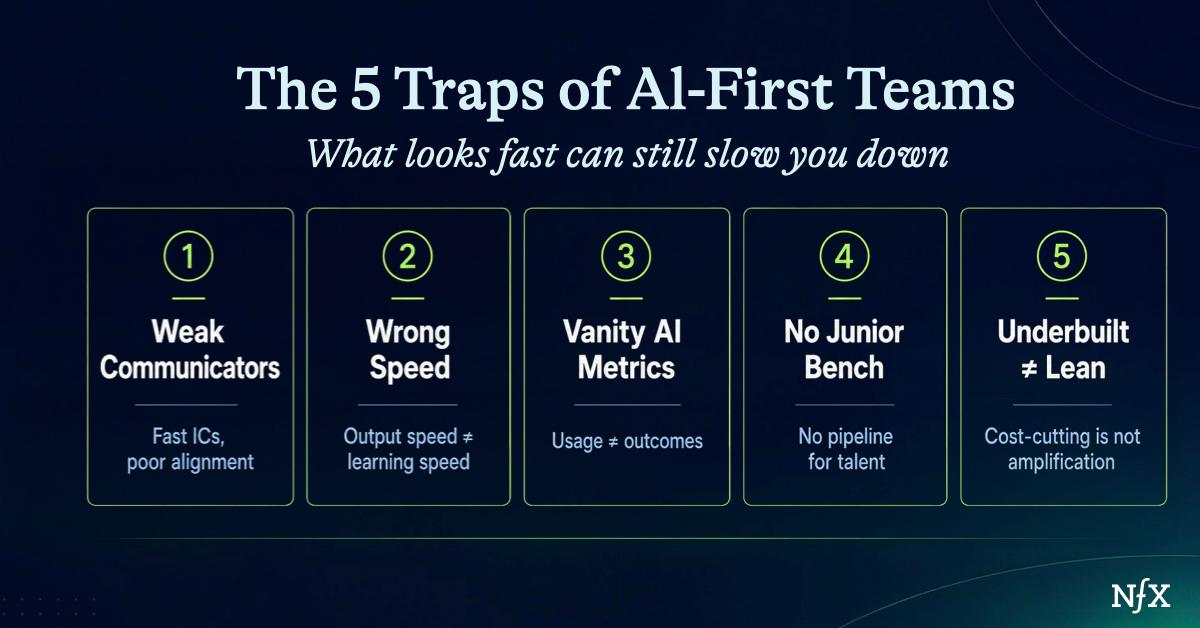
Trap 1: Hiring ICs Who Can’t Communicate
The party line is that AI has removed the need for the “pure” manager — and that’s often true. But look closer at who is actually pulling this off, and a pattern emerges.
The best AI-native teams are staffed with flexible, self-driven, experimentalist ICs — but the distinguishing trait is that these ICs are also tier-1 communicators. The programmer and the marketer are both moving fast and keeping each other in the loop.
Most companies adopt AI at the individual level without selecting for this trait. Each person becomes faster and more autonomous in their own bubble — but nobody’s coordinating across bubbles.
Speed at the individual level without alignment at the team level produces a graveyard of half-finished, un-launched work. Sure, everyone’s fast; but nothing’s live.

Trap 2: Measuring The Wrong Kind of Speed
Recently, Lenny Ratchitsky ran a survey of tech worker (and founder) sentiment. 97% even said that AI made them “better at their jobs,” but when they looked more closely at the results, they found that most measured that quality in terms of pure output and speed alone.
Speed is perhaps the most important part of building an early-stage company. But many are misinterpreting it today.
They measure speed in the old paradigm. The speed of going from 0 to 1. They are noticing that it only took “2 minutes to write a blog post with AI” or a “weekend to build a product,” and they are neglecting the fact that those are still rough drafts – they’re not actually shipping the output.
Today, you measure your learning speed. How long does it take to go from prototype to ship? From V1 to V2? That curve should be relentlessly accelerating.
If it’s not, you’re not moving faster. You feel fast. You feel productive. But you are spinning your wheels.
Trap 3: Tracking AI Usage as a Productivity Metric
Everything you do should be relentlessly focused on moving through the above product cycle of shipping and learning. What did you create today that did not exist yesterday? What did you learn that you did not know yesterday? And how does that translate into what you will do tomorrow?
Many high-profile companies have fallen into this trap of equating AI usage with outcomes. That’s the whole idea of tokenmaxing in a nutshell. It is no surprise that companies that once embraced tokenmaxing are now cutting back on AI spend and complaining about poor ROI.
(One metric that’s starting to emerge is revenue per million tokens – a refocusing on the idea that AI usage should be driving output, not serve as an end in itself. It will be interesting to see if this takes off).
Reward impact and results, not just tool dashboards or token use.
Trap 4: Not Hiring Juniors
Yes, AI is absorbing most of the work that trained junior employees for the last fifty years. The lazy answer is to stop hiring juniors and it’s an enormous mistake.
You are eating your seed corn, making your company vulnerable to poaching, cultural erosion, and knowledge loss. You are not training the next generation of the hires you want to see.
The smart answer is to train your juniors differently.
We suggest a new apprenticeship model: juniors who orchestrate agents (they’re probably already AI-native), operate inside tight eval loops, and take ownership of outcomes from day one. Each junior gets a project in their mission pod.
This is a high bar: today’s juniors must rise to the challenge of execution and self-directed ownership faster than any generation in history. Many will fail. But those that succeed? Those are A+ team players.
The companies that figure this out will own the next generation of talent. The ones that don’t will wake up in five years with no bench, and be left scrambling.
Trap 5: Mistaking Underbuilt for Lean
Small teams still need strong systems of accountability, direction, and opportunities to evaluate what’s working and what’s not.
If your team is automating what they can, iterating, and learning fast, and there is still work that isn’t getting done – you may need to hire more. It should not be your first reflex, but underbuilding your team is still a real risk if it is leaving potential growth on the table.
Your 10-person company still has the same obligations as the old 200-person one. Do not reduce the scope and vision to fit a small team, nor should you push your team beyond what is genuinely possible.
It comes down to this: AI-first is not AI-only. The companies that cut human support entirely watched quality collapse, customer satisfaction fall, and engineers get dragged into ticket queues — and had to restore human support anyway. The lesson isn’t that AI support fails. It’s that cost-cutting is the wrong function. Growth is the right one.
The Takeaway:
Don’t copy the org charts of 2010s SaaS companies. And don’t copy the AI-only extremes that are already showing cracks.
Find the nuance. Dissolve unnecessary boundaries in your org. Automate aggressively, but hire where it makes sense. Put AI into every workflow from the start. Keep humans close to customers and responsible for judgment. Measure outcomes per person – not AI vanity metrics.
The winning structure was never humans replaced by AI. It’s humans amplified by AI; the best companies understand this nuance and act on it.



As Founders ourselves, we respect your time. That’s why we built BriefLink, a new software tool that minimizes the upfront time of getting the VC meeting. Simply tell us about your company in 9 easy questions, and you’ll hear from us if it’s a fit.