

Most board meetings suck.
They are too long, too often, and a total waste of time for founders, the team, and investors.
This is why they have a bad rep. And many investors have argued that even having a board at all for an early-stage company isn’t worth it.
We disagree: if you do a board meeting right, it can be one of the best exercises you do as a company.
As an early-stage fund, NFX likes to lead rounds, price rounds, sit on the board – in some cases, even start it. Plus, the NFX GPs, as founders and CEOs, have run plenty of board meetings. So we’ve been on both sides of the table.
There’s a template for board meetings that I’ve seen work extremely well. If you run it this way, you’ll actually learn something, get high-leverage help, and keep everyone engaged.
Here’s how to run it
The First Half:
Attention spans are short (and sometimes VCs can become assholes who don’t pay attention). So the key is to keep the meeting short and strategic – there is no reason to go over 60-90 minutes.
These are the must-haves in order.
Step 1: Start with your mission and vision
Get everyone fired up and keep their eyes on the big mission that got them on the board in the first place. Creating energy right off the bat of a presentation is key to getting people activated. We actually recommend you start every meeting this way – whether that’s your customers, team members, or investors.
At NFX, we start all of our quarterly meetings with 1-2 minute-long hype videos to create this effect. It just brings the energy in the room up, and we’ve found it keeps people more engaged.
Step 2: Simple Financials
At the early stage, we only really need to know how much money you have in the bank, your burn rate, and your runway. Usually there’s no need to get too deep into everything else (unless it’s the yearly budgeting meeting).
The key statistic here is your runway. Your runway helps us frame the rest of your milestones and goals, and should affect how you prioritize.
For example:
- If you just raised and have 18-24 months of runway, it’s a great time to set ambitious goals. Plan for the strategy, budget, and people required to achieve them.
- If you have more than 12+ months of runway, you can afford to stay heads down and focus largely on your technical or product milestones. Are you on track for your goals? Do you need to adjust?
- If you have less than 12 months of runway, you need to pick your head up and start thinking about fundraising. Of course, the best way to prepare for a fundraise is to hit your milestones, but at this point you need to begin devoting efforts to the finer points of your raise: like deck narrative, getting together a prospect list, building a data room, and more. I cover all of this in detail here.
Critically, if you don’t seem to be hitting your milestones within the 12-month time period, that’s when the board can talk about extensions, reducing burn, or other options. We want to have those discussions earlier, rather than later.
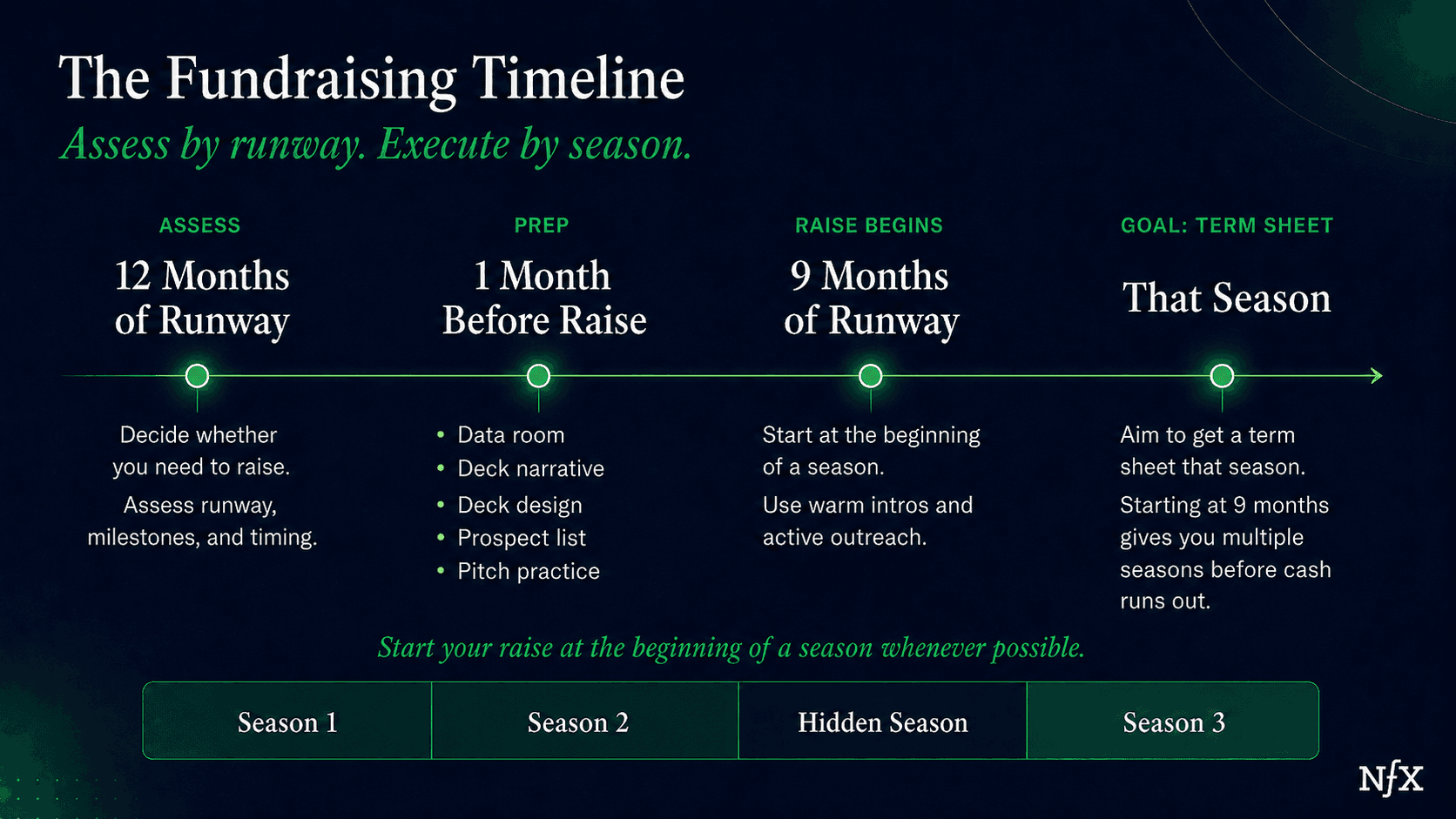
- If you only have 3-6 months of runway, you are in red flag territory. Fundraising should become your number one priority.
Ideally, at this point you are already talking to investors and in term-sheet discussions. If not, this is where the board can get into emergency fundraises, internal rounds, and other unpleasant but necessary decisions.
The runway goal helps frame everything that comes next. And if you need to be talking fundraising, your board is a great resource – if there is anything your investors know about, it should be this.
Step 3: Run a quarterly goal reality check
Every quarter, commit to a few larger goals that will advance you towards your mission and vision. Importantly, give each one specific weight. They are all important, but you must calibrate what needs to be prioritized.
You will be tempted to weigh them all equally. This is a mistake. In fact, it tells us, as your board, that you don’t know how to prioritize correctly.
I’ll give an example. I was once running this exercise with a founder who had five or six major quarterly goals. A few were technical, and one of them was fundraising. They had less than 4 months of runway in the bank, yet their technical and fundraising milestones were given the same weight. They literally looked the same on the slide – when in reality, fundraising should have been 95%+ of the slide in giant font.
See below:
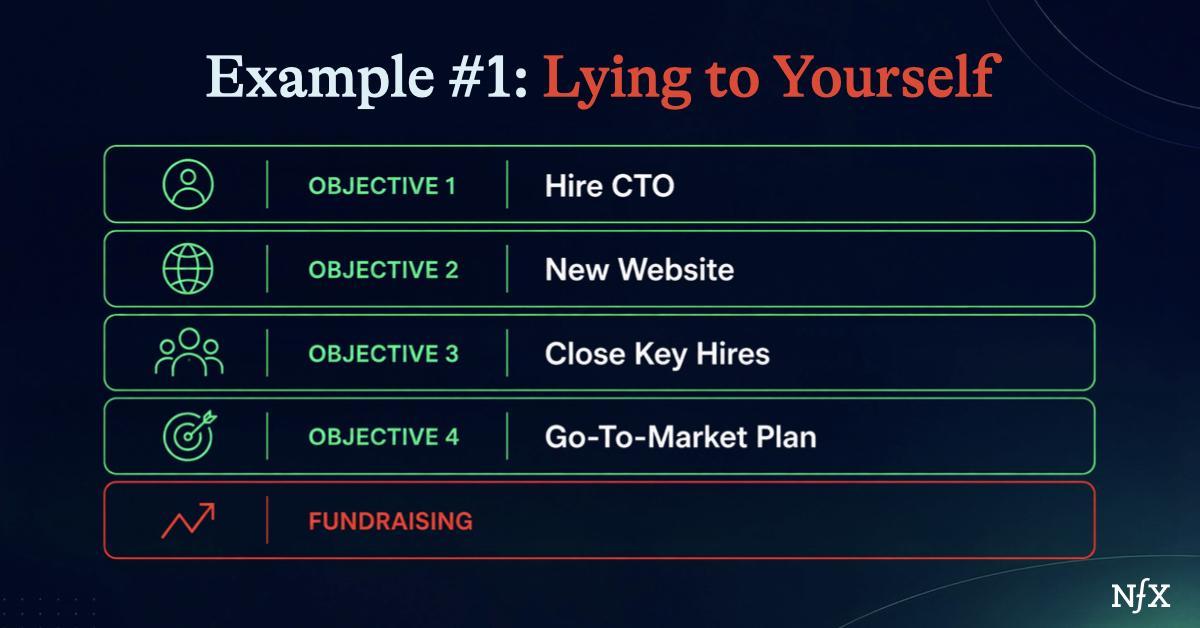
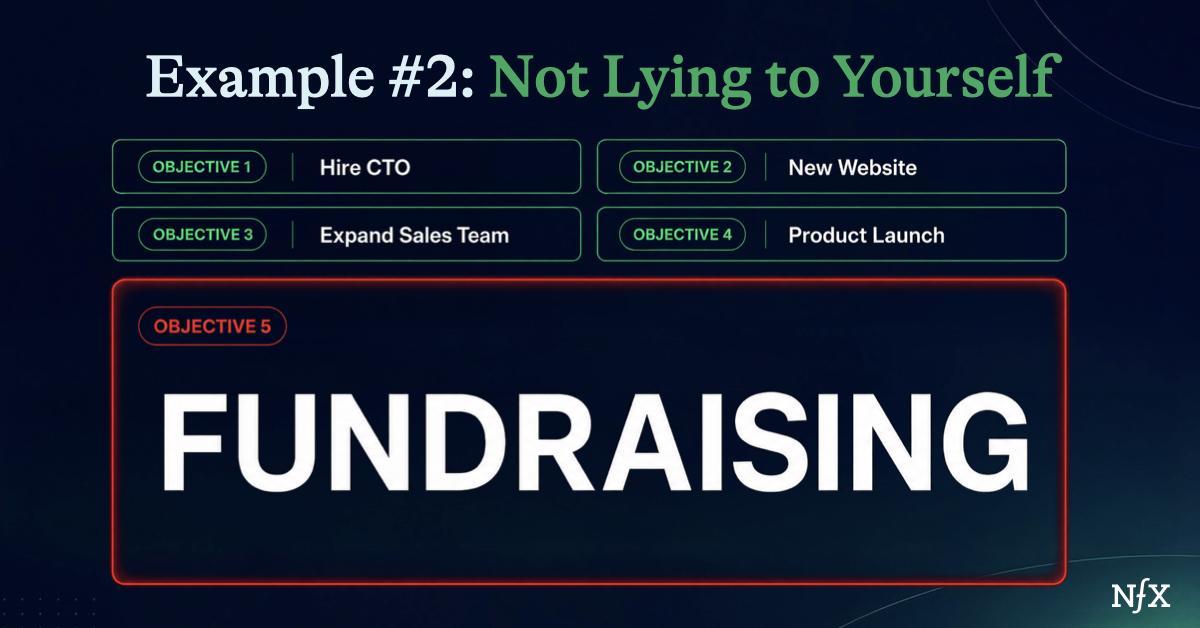
If you are achieving all your technical milestones, but have less than 4 months of runway, all is not well! It doesn’t matter how much green is on the slide. You are lying to yourself. It’s not intentional. But it’s very easy to do.
Here’s how to not lie to yourself: Use the design of your slides as a forcing function to tell your board (and yourself) what the most important things are, and if they are really happening.
If things are in the red, it does not mean you failed. It means we need to change the plan. The only way you can truly fail is if you lie to yourself and meander along, thinking things are fine when they aren’t.
This section of your board meeting (and the above design) is to create accountability so you never end up not realizing you’re in a bad position.
Changing the plan is ok; misleading yourself is not.
The Meat of The Meeting
Make sure the above goes first, and fast. It gets everyone on the same page and holds you accountable.
The next portion of the meeting is focused on strategic areas and problem-solving.
The Strategic Areas:
Pick one or two strategic areas to focus on. No more. Examples for strategic discussions/decisions include:
- Fundraising – strategy and milestones
- Prioritizing product development
- M&A offers
- Major legal issues
- Hiring CBO/CMO/CSO and other top roles
- Adding KOLs / Scientific advisors
Whatever strategic areas you decide on are up to you, but this is non-negotiable: come with a plan. Don’t come with just a question. The strategic discussion is not “what should we do?” It’s “here’s what we’re planning to do, and here’s why.”
We invested in a person with a plan. Be that person. It’s actually a red flag to us if you show up like this: ¯\_(ツ)_/¯.
The Board Matters:
There is a formal part of every board meeting where only board members vote on official items.
The most common item here is the approval of equity grants. Make this painless: keep a simple spreadsheet with each person’s name, what they do, how many shares they’re getting, what that represents on a fully diluted basis, and their vesting schedule.
“We are approving X shares representing Y% of our ESOP. With this approval, we’ve now granted Z shares, representing W% of the pool.”
That’s it.
Finally, leave a few minutes at the end for a directors-only session — a quick sync between board members, without the founders, in case there are any questions they want to raise among themselves. This is standard practice, not a bad sign.
Optional Additions:
If you have time, a board meeting is also a good place to occasionally have your management team present their areas—marketing, technology, whatever is most relevant.
Also, don’t neglect the soft skills – get to know your board members, have a dinner or lunch where your investors can meet the team and other investors in a social setting. It helps build trust and good relationships, and sometimes we get the most important information about the company that way.
The Dos and Don’ts
Just as important as the structure is what to avoid. These are the mistakes I see most often.
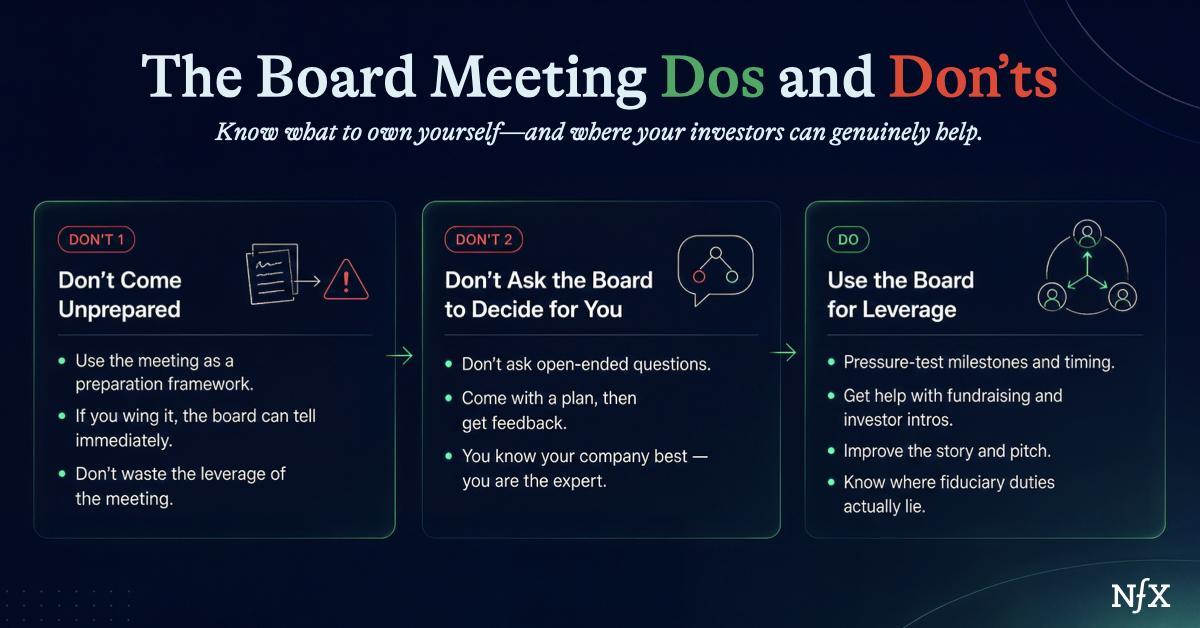
Don’t come unprepared. Everything above is a preparation framework. If you show up without having done the work, the board can tell immediately, and it’s a very bad look. Once you have a board template (and with the aid of AI), the prep shouldn’t take longer than a few hours max.
No surprises in board meetings. Send the deck a few days before so your board members can read and come prepared (they should be prepared too!) Have one-on-one calls with board members if there are any sensitive matters (founders’ compensation raise, adding to ESOP, legal matters, etc). Board drama is great for movies, not for most successful companies.
Don’t ask the board to decide for you. We already mentioned this, but I’ll reiterate. You have more information about your company than your board does. You don’t have to be perfect, but you do need to have a plan.
Do use the board for what it’s actually good at. So where can the board genuinely help? With the things where investors see more than you do.
- We see a lot of companies. We can tell you whether your milestones are the right milestones.
- We can tell you whether it’s a good time to fundraise.
- We can connect you to more investors to help with that fundraising.
- We literally see thousands of pitch decks. We can tell you whether yours is going to hit with investors.
- We can connect you to resources to help you tell that story better.
- We can help you amplify your story in our own networks and beyond.
- We can help with hiring
- And more – depending on your board members.
Do understand where everyone’s fiduciary duty actually lies.
When an investor sits on your board, they have a fiduciary responsibility for the company and all the company shareholders FIRST. While they are representing their funds and the fund LPs, the company-board duty takes precedence. They cannot say, “This hurts the company/common holders, but improves my fund’s return, so I must support it for my LPs.”
But, a VC’s economic incentives still come from their fund. They can’t legally prioritize the fund over the company, but you do have a right to point out this fact, and any conflicts that may arise from this incentive.
If a particular decision creates a material conflict, you can call it out and ask the director to disclose the conflict and recuse themselves from the discussion and vote.
The same goes for your lawyers, by the way. In their case, the company’s lawyer is not your lawyer. If your personal interests as a founder ever diverge from the company’s, they are not on your side of that line.
None of this means the people around your board table are against you. It means you should know whose interests everyone is actually bound to serve, and keep it in mind.
Why Bother With a Board Meeting at Early-Stage?
If you have bad investors who just mess with you, you’re running a board meeting every month or a five-hour marathon every quarter — maybe then don’t bother with a board meeting. But that’s an argument against bad board meetings, not against all board meetings.
Done right, a board meeting forces you to measure yourself against what you said you’d do. Over time, you will create a record showing what you planned and what you actually did. It will help you and the company achieve more, and prove to the next round of investors that you can plan, execute, and deliver.
Most founders feel like they’re doing fine day-to-day — the board meeting is where you get to test yourself and see if it’s actually true.



As Founders ourselves, we respect your time. That’s why we built BriefLink, a new software tool that minimizes the upfront time of getting the VC meeting. Simply tell us about your company in 9 easy questions, and you’ll hear from us if it’s a fit.